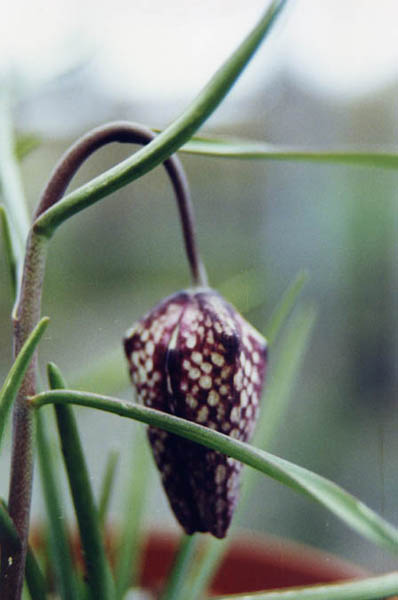
Perennial bulbous plant of the Liliaceae family, the Guinea-hen Flower is native to the wet and floodplain meadows of temperate Europe, from the Loire and Rhine valleys to Central and Balkan Europe. It naturally grows in tall grass meadows, riverbanks, and cool pastures regularly submerged in winter and early spring.
It raises slender, solitary stems from 20 to 40 cm, bearing a few narrow, linear, glaucous green leaves, arranged sparsely. The flower, hanging, in an elongated bell shape with six fleshy tepals, presents the pattern that earned it its name: a tight checkerboard of dark purple-brown and pale pink-lilac squares, with striking precision and regularity, reminiscent of the guinea fowl's plumage. The stem curves like a crook just above the flower, an immediately recognizable detail.
In its natural habitat, its flowering extends from April to May. In cultivation, it generally blooms in April.
It readily naturalizes in cool meadows and is suitable for wet gardens with a natural character. It requires a cool to moist soil during growth, drier in summer after dormancy, in a sunny to semi-shaded position. In Great Britain, some fritillary meadows are classified as protected habitats.