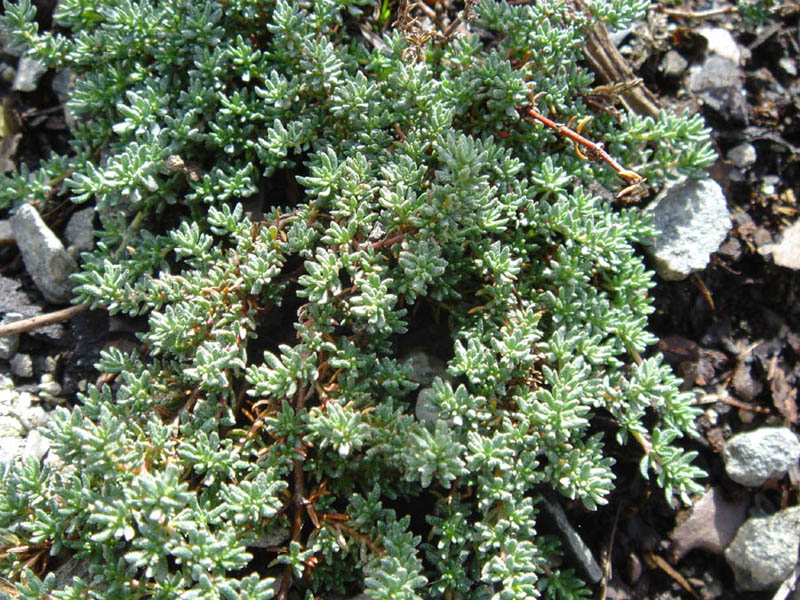
Perennial of the Frankeniaceae family, Frankenia laevis is a species of the Atlantic and Mediterranean coasts of Western Europe, present on the British, French, Iberian coasts and in North Africa. It colonizes salty or subsaline environments, maritime cliffs, low coastal lawns, rocky crevices and very exposed stony substrates.
It forms creeping mats or very dense cushions, 5 to 10 cm high, with woody and finely branched stems. The leaves are tiny, narrow, with rolled edges, tightly packed along the stems in a compact network that from afar evokes certain heathers or plants with scaly foliage. In summer, their hue is medium green to gray-green; in winter and early spring, they turn to deep orange-red to reddish-brown, giving the plant a completely different and remarkable appearance.
The flowers, tiny, with five slightly fringed lilac pink to bright pink petals, bloom in large numbers among the foliage. In its natural habitat, its flowering extends from June to August. In cultivation, it can begin as early as the end of May depending on the exposure.
It requires a poor, sandy or stony soil, perfectly drained, in full sun, and remarkably tolerates drought, wind, and salt. It dreads excessive winter moisture.