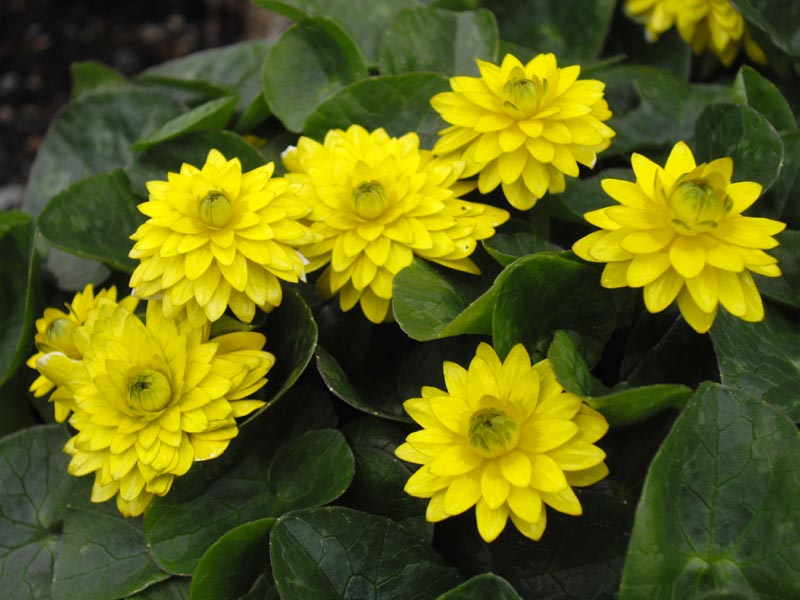
An ancient horticultural cultivar of the Spring Buttercup, a tuberous perennial of the Ranunculaceae family, known and cultivated for several centuries for the remarkable density of its fully double flowers.
It forms small low and spreading clumps, 8 to 12 cm in height, which can quickly cover a notable area. The foliage is cordate, glossy, a very deep dark green, dense and tight, forming a compact carpet on which the flowers stand out brightly.
The flowers are fully double, composed of numerous rows of glossy petals from bright yellow to lemon yellow, arranged in a tight rosette around a small green heart often visible at the center. This floral architecture, which from a distance evokes a small miniature peony, is one of the most characteristic traits of this cultivar. Sterile, it does not produce seeds and presents no risk of spontaneous dissemination.
Its flowering in cultivation extends from February to April depending on the regions and exposure. The plant then completely disappears in summer, entering a long summer dormancy.
In cultivation, it prefers a fresh soil, rich in humus, well-drained during the rest period, in semi-shade or under light cover. Propagation is exclusively by division of the tubers, preferably in autumn.