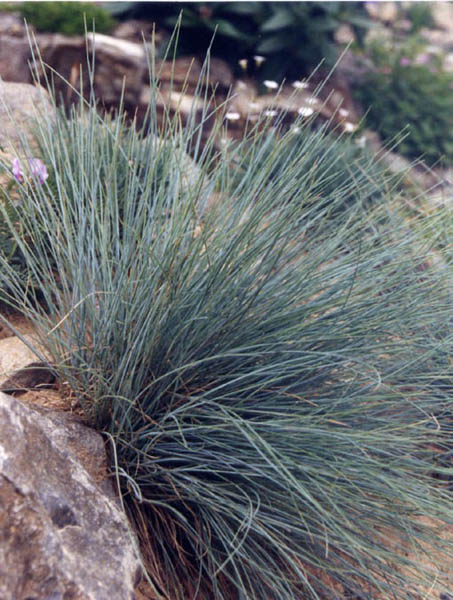
A perennial from the Poaceae family, Blue fescue is native to Southern and Central Europe, with a range centered on the Mediterranean and sub-Mediterranean regions, notably southern France, Spain, and the Balkans.
It naturally grows in dry grasslands, rocky areas, calcareous scree, and sunny slopes, on poor, well-drained substrates, often calcareous or slightly acidic depending on the origin, generally at low and medium altitudes.
It forms dense, hemispherical, compact, and regular clumps, 20 to 30 cm in height, composed of fine, persistent, stiff, and narrow leaves, rolled into needles. Their color is one of the most immediately distinctive features of the species: an intense blue-gray to steel blue, due to a waxy bloom covering the leaves and varying according to cultivars, some tending towards blue-green, others towards an almost metallic blue.
The floral spikes, slender and discreet, rise above the clumps on fine stems of 30 to 40 cm, bearing narrow panicles of a glaucous green to slightly purplish. In its natural habitat, its flowering extends from May to July. In cultivation, it occurs at roughly the same dates.
In cultivation, it requires a well-drained soil, dry to fresh, poor to moderately fertile, in full sun; it declines in heavy, damp soil or in shade. A severe pruning at the end of each winter, cutting back the clumps with scissors, removes dried leaves and stimulates dense and colorful regrowth. Dividing every two to three years also helps maintain the vigor and beautiful glaucous hue of the clumps.