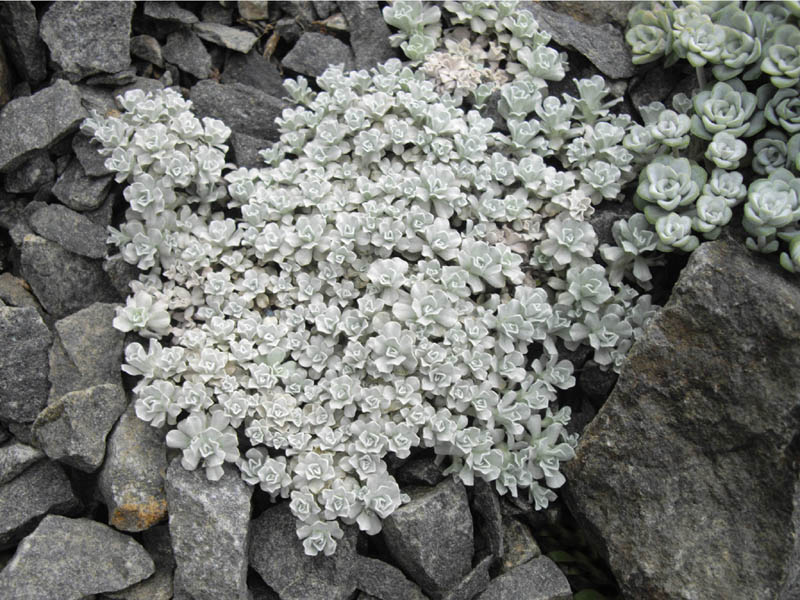
Perennial of the Asteraceae family, endemic to Tasmania, where it colonizes alpine lawns, rocks, and granite fissures, generally between 1,200 and 1,600 meters in altitude. It bears the vernacular name of Creeping Ewartia, which perfectly summarizes its behavior.
It forms small, creeping, and very dense mats, spreading close to the ground at only a few centimeters in height. The leaves are small, spatulate, covered with a silvery white woolly tomentum that gives them a cottony and luminous appearance, a striking characteristic of the plant in its rocky environment.
The capitula are small, cream-white to pure white, borne individually on very short stems, surrounded by woolly bracts that distantly resemble the edelweiss of the Alps. In its natural environment, its flowering extends from December to February, corresponding to the austral summer.
In cultivation, it requires perfect drainage, a poor and stony substrate, in full sun. It dreads stagnant winter moisture much more than cold. Cultivation in an alpine trough or in an alpine house is recommended in regions with wet winters.