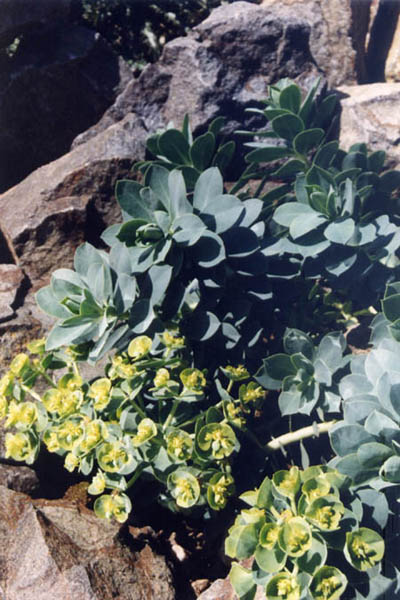
Perennial of the Euphorbiaceae family, the Corsican spurge or myrsine spurge is a species from the eastern Mediterranean basin and Pontic regions, naturally present from the Iberian Peninsula to Asia Minor, with locations in the Balkans, Italy, and Mediterranean France. It occupies rocky areas, limestone screes, open garrigues, and dry mountain lawns, sometimes up to 2,000 meters in the Balkan mountains.
Its habit is quite characteristic: the stems are creeping to procumbent, spread out in a star shape from the base, 15 to 30 cm long, allowing it to elegantly cascade over walls and rock garden borders. The leaves, tightly packed and overlapping along the entire length of the stems, are fleshy, oval to spatulate, with a very pronounced glaucous green tending towards blue-gray, often with a whitish margin; their spiral arrangement almost evokes a succulent plant.
The terminal umbels, wide and flat, bear bright sulfur-yellow to yellow-green bracts, very luminous in spring. In its natural habitat, it blooms from March to May. In cultivation, it often blooms as early as February in mild regions.
It requires perfectly drained soil, poor, preferably calcareous, in full sun. It tolerates drought well and withstands dry cold adequately. It is one of the spurges best adapted to rock gardens. The latex is irritating.