Perennial of the Euphorbiaceae family, the Irish spurge is a species with a remarkably restricted Atlantic distribution: it is mainly found in Ireland, in the southwest of Great Britain, in the northwest of the Iberian Peninsula and, in France, mainly in the Atlantic regions and in the western Pyrenees. It occupies damp undergrowth, hedges and fresh edges, on acidic to neutral soils, rich in humus.
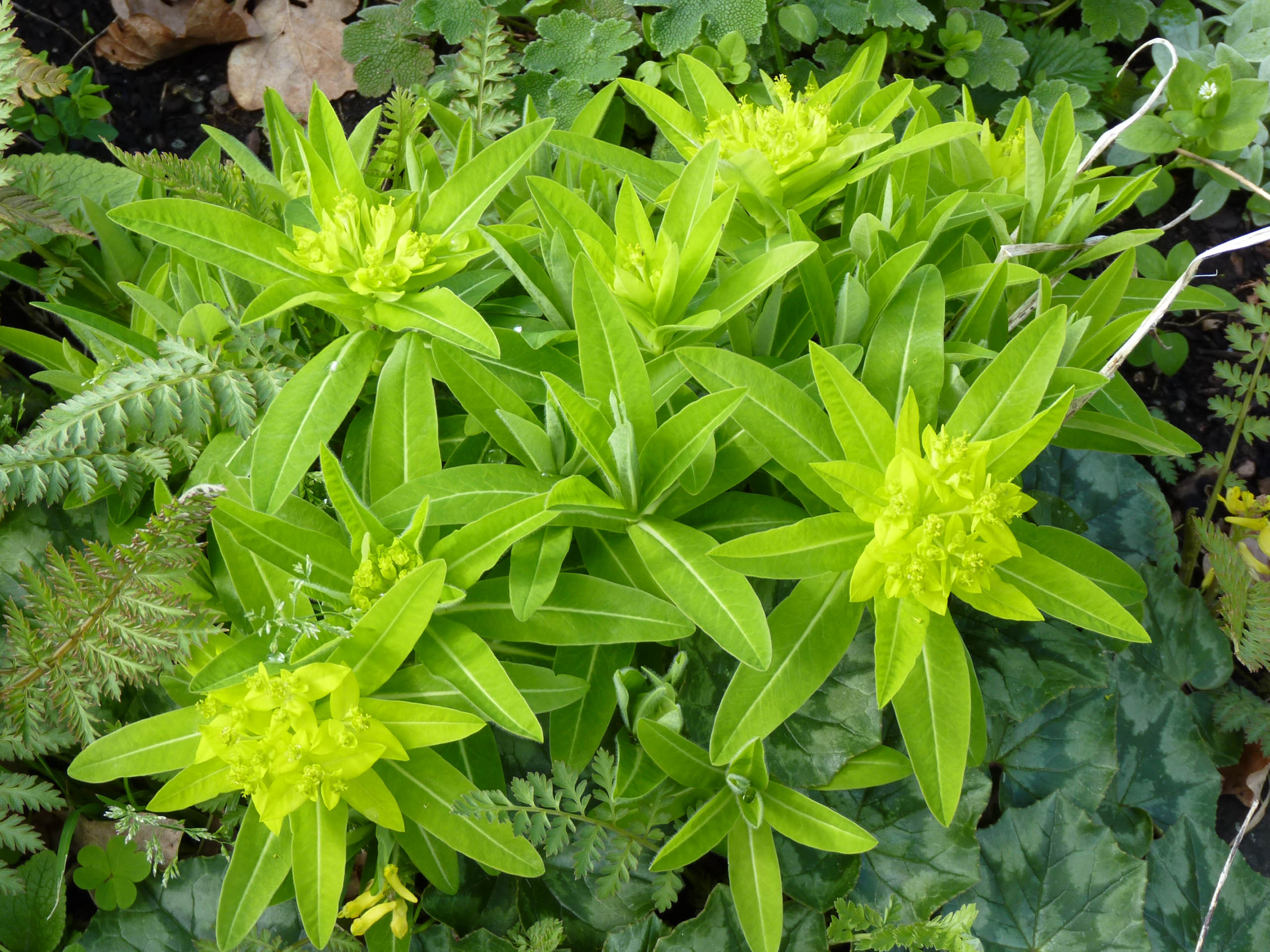
It forms upright and fairly compact clumps, reaching 30 to 60 cm in height. The leaves are oblong to elliptical, medium green to bright green, with a well-marked central vein, arranged spirally along the stems. At the time of flowering, the whole plant takes on a particularly bright green-yellow to chartreuse yellow hue, with bracts and upper leaves blending into the same brilliance.
The cyathia are borne in dense terminal umbels, surrounded by large rounded bracts of an intense yellow-green that constitute the main visual effect. In its natural habitat, its flowering extends from April to June.
It appreciates in cultivation a cool, well-drained soil in winter, enriched with organic matter, in a semi-shaded position. Like all spurges, its latex is irritating. Its bright habit in spring makes it a valuable plant for undergrowth compositions or gardens with a natural character.