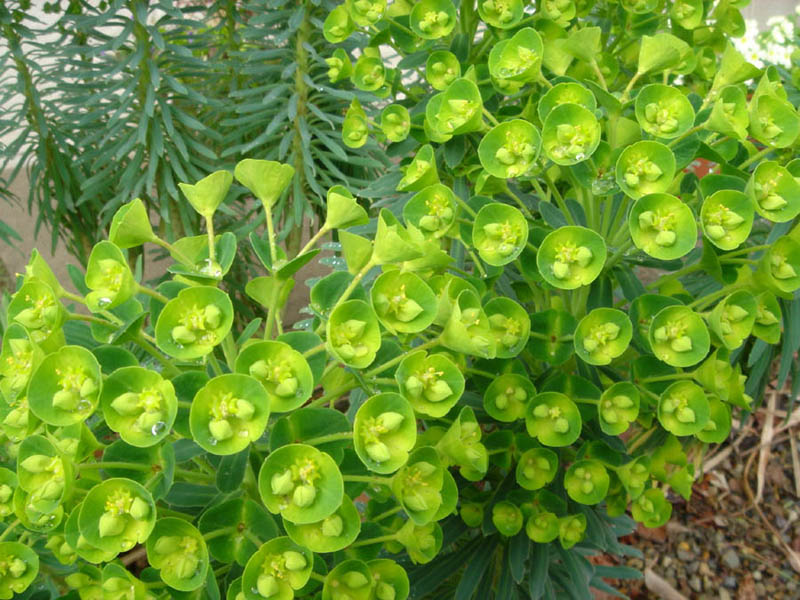
Perennial of the Euphorbiaceae family, Euphorbia characias is a species of the western Mediterranean basin, present from the Iberian Peninsula to the Adriatic coasts, including southern France and Italy. It colonizes scrublands, maquis, rocky areas, and sunny embankments, on poor, dry, and well-drained soils, generally calcareous.
It forms large, persistent, and architectural shrubs, reaching 80 to 150 cm in height. The upright stems, woody at the base, bear linear to lanceolate leaves, in a glaucous green to blue-gray, arranged in dense rosettes that persist all winter and give the plant a remarkable presence even outside of flowering.
The cyathia are grouped in large, terminal, cylindrical, and very dense umbels, surrounded by green-yellow to sulfur-yellow bracts; in the subspecies characias, the nectar glands are dark brown-red, which immediately distinguishes it from the subspecies wulfenii whose glands are yellow. In its natural habitat, its flowering extends from February to May. In cultivation, it can bloom as early as January in mild regions.
It requires perfectly drained soil, full sun exposure, and tolerates summer drought well once established. It is moderately cold-resistant and can suffer in harsh winters combining frost and humidity. Its white latex is highly irritating. The stems that have flowered are cut at the base in summer to promote the renewal of the clump.