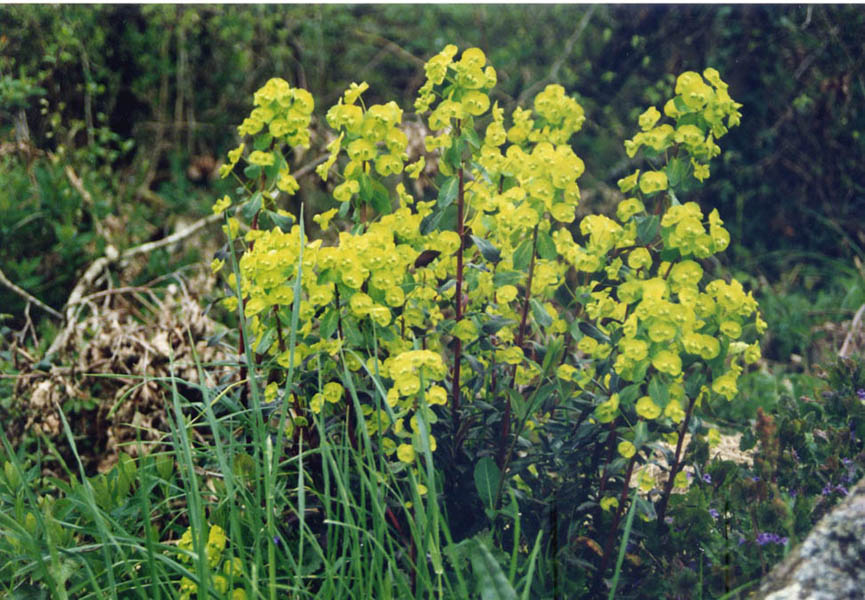
Perennial of the Euphorbiaceae family, the wood spurge is a species widely spread in Europe, from the Iberian Peninsula to the Caucasus, also present in North Africa. It colonizes cool and shaded woodlands, forest edges, hedges, on generally clayey to silty soils, well supplied with humus, in plains as well as in mountains up to about 1,200 meters.
It forms upright, semi-evergreen clumps, 30 to 60 cm in height. The stems are reddish at their base, bearing oblong, dark green leaves that are slightly shiny on top, paler underneath, arranged in a spiral along the stem. In autumn and winter, the leaves often take on reddish or purplish hues, a particularly marked characteristic in some cultivated forms.
The flowers, reduced to simple structures surrounded by bright yellow-green cup-shaped bracts, form very decorative terminal umbels. Like all spurges, the plant produces a white, irritating latex, toxic if ingested, and can cause skin reactions.
In its natural habitat, its flowering extends from March to May. In cultivation, it can bloom as early as February in mild regions.
It tolerates dry shade, withstands poor soils and some summer drought once established. Place it sheltered from the wind, avoiding any skin contact during handling.