syn. Erysimum pumilum, Erysimum helveticum ssp. pumilum
syn. Erysimum pumilum, Erysimum helveticum ssp. pumilum
Perennial of the Brassicaceae family, native to the western and central Alps, found in France, Switzerland, and Northern Italy. It colonizes rocky areas, scree, pioneer grasslands, and windy ridges on generally siliceous or mixed substrates, at altitudes between approximately 1,800 and 3,000 meters.
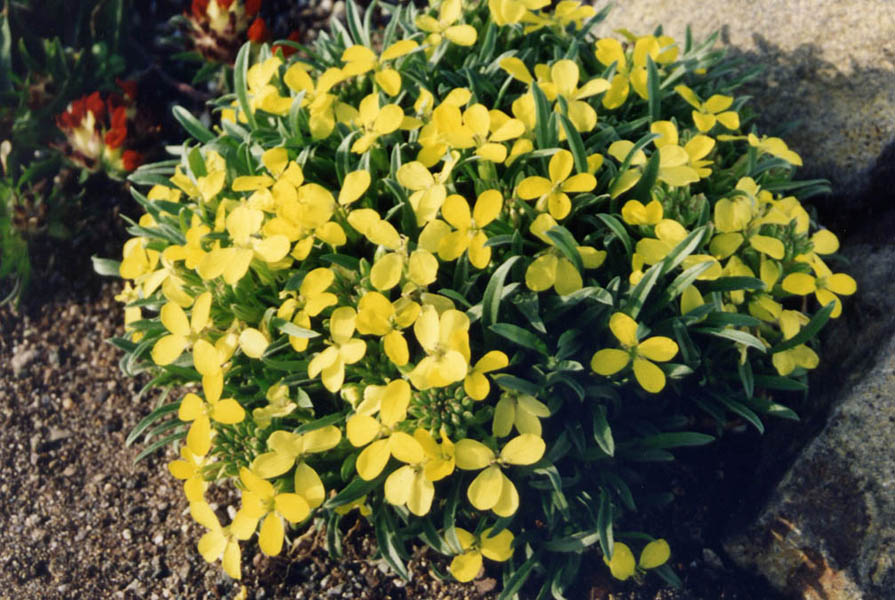
The plant forms a dense and compact cushion, remarkably well-defined, hardly exceeding 10 to 12 cm in height. The leaves are narrow, linear to lanceolate, finely hairy, with a characteristic grayish-green, tightly arranged along the stems in a structure reminiscent, in miniature, of wallflowers to which it is closely related.
The tetrapetalous flowers, of a bright sulfur yellow, unfold in dense clusters that almost entirely cover the foliage at the time of full bloom. In its natural habitat, its flowering extends from July to August depending on altitude; in cultivation on plains, it can occur as early as May to June.
In cultivation, it requires a very well-drained soil, poor to moderately fertile, in full sun exposure. It dreads stagnant winter moisture more than cold. A sloping rockery, a wall, or an alpine trough suits it perfectly.