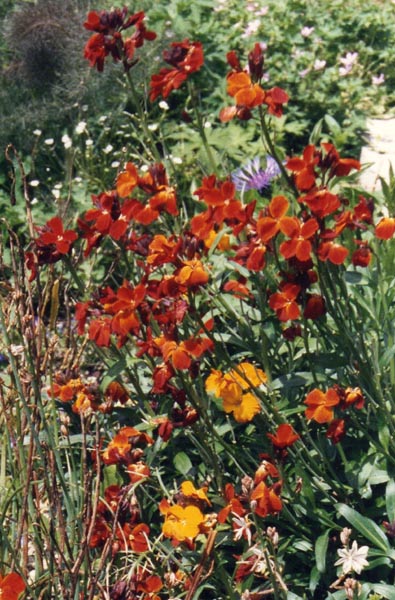
Short-lived perennial, often grown as a biennial, from the Brassicaceae family, the wallflower is native to the Aegean region and the eastern Mediterranean. Naturalized for centuries throughout Europe, it spontaneously colonizes old walls, ruins, limestone rocks, and coastal cliffs, where its roots infiltrate the smallest cracks.
It forms a semi-woody bush at the base, upright, 30 to 60 cm in height, with branched stems bearing narrow, lanceolate, grayish-green leaves. The wild flowers, with four petals arranged in a cross, are bright golden yellow to orange, grouped in dense terminal clusters. The fragrance is intense, sweet, and suave, particularly pronounced in the evening and in warm weather; it is one of the most fragrant spring plants in traditional gardens.
Horticultural selection, conducted since the Middle Ages, especially in England, has profoundly transformed the floral palette of the species. The cultivars now cover a range from pale yellow to dark burgundy red, including coppery orange, reddish-brown, and velvety purple, far removed from the original yellow. They are often offered in seed mixes, producing these warm and contrasting color combinations characteristic of traditional gardens in spring.
In its natural habitat, its flowering extends from April to June. In cultivation, it occurs from April to May depending on the region. It requires well-drained soil, preferably calcareous, poor to moderately fertile, in full sun, and dislikes stagnant winter moisture.