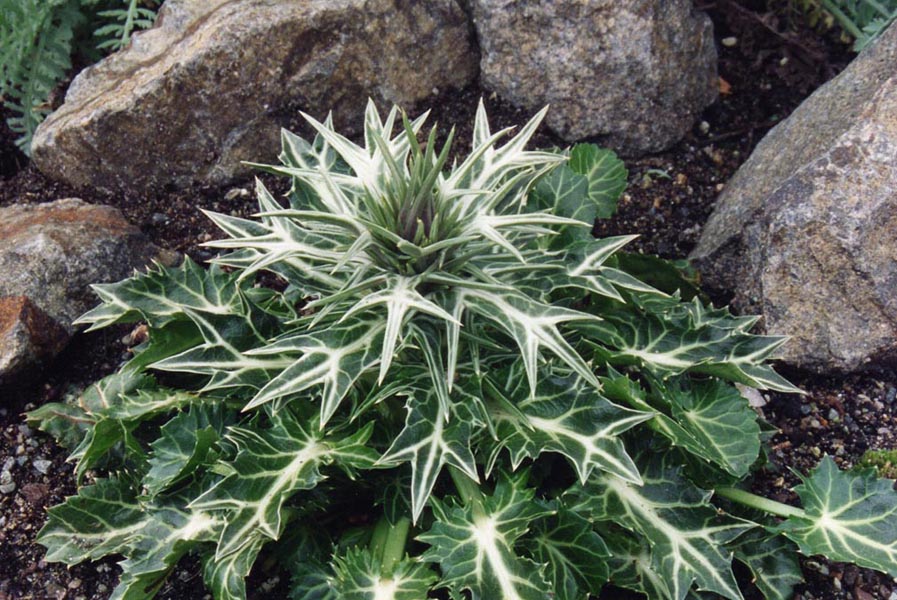
A perennial from the Apiaceae family, Eryngium variifolium is native to Morocco, where it grows in the mountainous areas of the Atlas, on rocky terrain, limestone slopes, and high-altitude dry meadows. Its name, which literally means "with variable leaves", refers to the marked difference between the basal leaves and the cauline leaves.
The basal rosette is one of the major assets of the species: the leaves are rounded to kidney-shaped, leathery, with a deep dark green color, traversed by a network of pure white veins that provide a graphic elegance similar to that of a Cyclamen. This evergreen foliage remains decorative all year round. The cauline leaves, on the other hand, are narrow, sessile, very spiny, with a completely different appearance.
The flowering stems reach 40 to 60 cm, very branched, bearing many small whitish to slightly bluish capitula, surrounded by narrow, spiny, silvery-white bracts. The entire flowering stem takes on a simultaneously airy and architectural appearance. In its natural habitat, its flowering extends from July to August. In cultivation, it occurs from June to August.
It requires well-drained soil, poor to moderately fertile, in full sun. Relatively hardy, it withstands moderate negative temperatures provided the soil is dry in winter. Its persistent and marbled winter foliage makes it a plant of dual interest, as valuable outside of flowering as during.