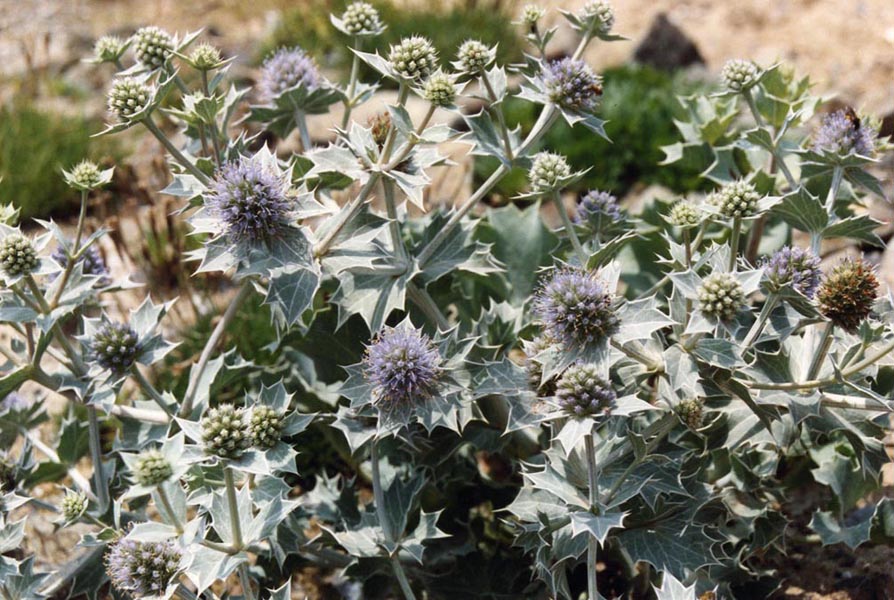
Perennial of the Apiaceae family, the sea holly is widespread on the sandy coasts of Atlantic and Mediterranean Europe, from the shores of the Black Sea to the British coasts. It colonizes mobile and semi-fixed dunes, consolidated strandlines, and coastal sands exposed to sea spray, wind, and intense summer drought. It is one of the most characteristic plants of the European dune flora.
The plant forms a rounded, spreading bush, reaching 30 to 60 cm in height, anchored by a deep and powerful root system that allows it to stabilize loose sand. The foliage is among the most unique: the leaves are rigid, leathery, with a very pronounced metallic silver-blue-gray, palmately lobed with broad lobes ending in robust spines, with well-visible white veins. This glaucous coloration, due to a thick waxy cuticle, is a remarkable adaptation to dehydration and salty spray.
The flower heads are globular, surrounded by broad, spiny bracts, of the same blue hue as the foliage. The flowers are blue-lilac to blue-violet. In its natural habitat, it blooms from July to September. In cultivation, it occurs from June to August.
Its fleshy roots were once harvested and consumed candied in sugar, reputed to be tonic and aphrodisiac; this practice is mentioned as early as the 16th century in England. The species is now protected in several countries due to the regression of dune habitats.
In cultivation, it requires very well-drained, sandy or gravelly soil, in full sun. It does not tolerate transplantation well once established and dislikes stagnant winter moisture. To be reserved for dry gardens, open rockeries, and compositions with a coastal character.