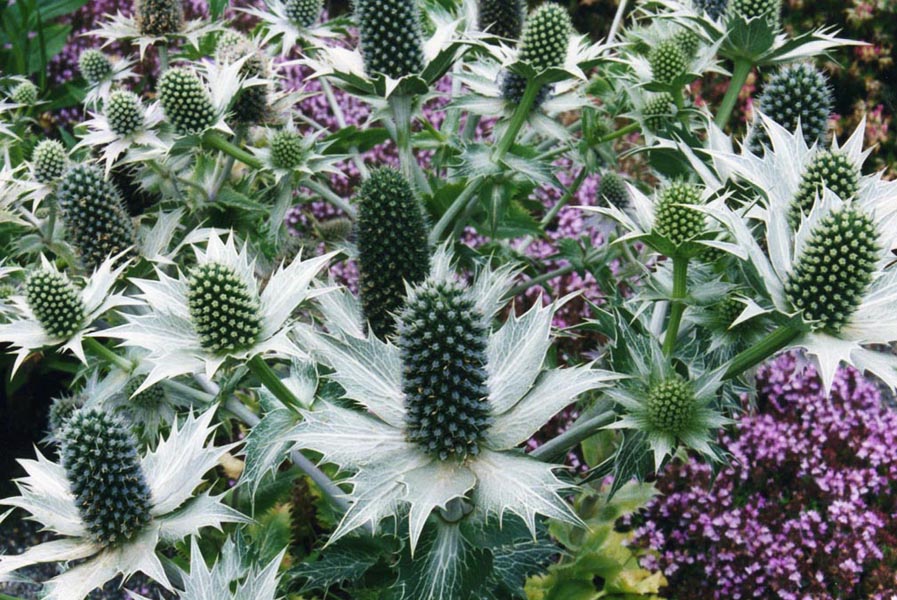
Biennial or monocarpic from the Apiaceae family, Eryngium giganteum is native to the Caucasus and Iran, where it grows on rocky slopes, edges, and open grounds. In cultivation, it behaves as a biennial that self-seeds abundantly and thus perpetuates itself without intervention, earning it the English nickname "Miss Willmott's Ghost," named after a famous English botanist of the early 20th century who was said to discreetly sow its seeds in the gardens she visited.
The plant reaches 80 to 150 cm in height when in bloom, with robust stems highly branched at the top, bearing numerous ovoid to cylindrical, large, and well-developed flower heads. The involucre of broad, rigid, toothed-spiny bracts, a brilliant silvery white at maturity, is one of the most spectacular of the genus. The central flower heads, a glaucous green-blue, strongly contrast with this immaculate collar.
The basal leaves are heart-shaped, long-petioled, a bright green; the cauline leaves become progressively sessile, clasping, and very spiny towards the top of the stem. In its natural habitat, it blooms from July to August. In cultivation, it blooms from June to August, and the entire plant then dries on the stem, taking on a silvery straw hue that remains decorative all winter.
It requires well-drained soil, poor to moderately fertile, in full sun. It tolerates drought and dislikes heavy soils. Propagation is exclusively by seed, to be done immediately after seed collection for best results.