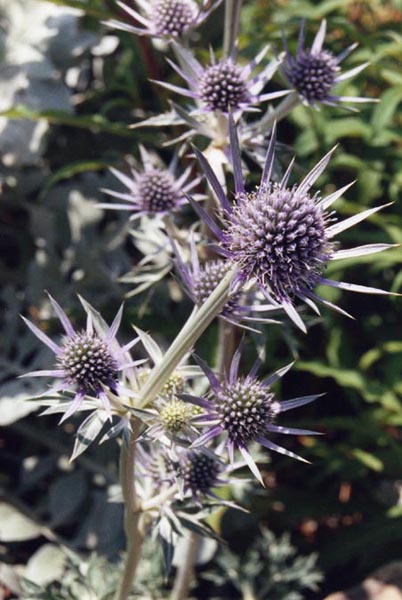
Perennial of the Apiaceae family, Eryngium bourgatii is native to the Pyrenees and the mountains of northern Spain, where it grows on rocky lawns, limestone scree, and sunny slopes, generally between 1,000 and 2,400 meters in altitude. It is one of the most representative eryngos of the Pyrenean mountain flora.
The plant forms a spreading basal rosette, well characteristic even outside flowering: the leaves are palmately lobed, leathery, dark green traversed by a network of very marked white veins that give them a unique marbled or veined appearance in the genus. The erect flowering stems reach 30 to 50 cm, branched at the top, bearing numerous spherical to ovoid flower heads.
Each capitulum is surrounded by an involucre of long, narrow, spiny bracts, of a silvery-blue to deep blue-violet, radiating star-like around the central bud. At maturity, the entire stem, bracts, and capitula take on a remarkable blue to steel-blue hue. In its natural habitat, its flowering extends from July to August. In cultivation, it occurs from June to August depending on exposure.
It requires well-drained soil, poor to moderately fertile, in full sun. It tolerates summer drought well once established, and dislikes heavy and wet soils in winter. Perfectly suited to rock gardens, dry gardens, and plantings with a mineral character.