Perennial of the Asteraceae family, Erigeron uniflorus is a circumpolar arctic-alpine species, found in the Alps, the Pyrenees, the Carpathians, Scandinavia, and the arctic regions of Eurasia and North America. It occupies short grasslands, moraines, fine screes, and snow hollows, generally between 2,000 and 3,500 meters, on poor and well-drained substrates, often siliceous.
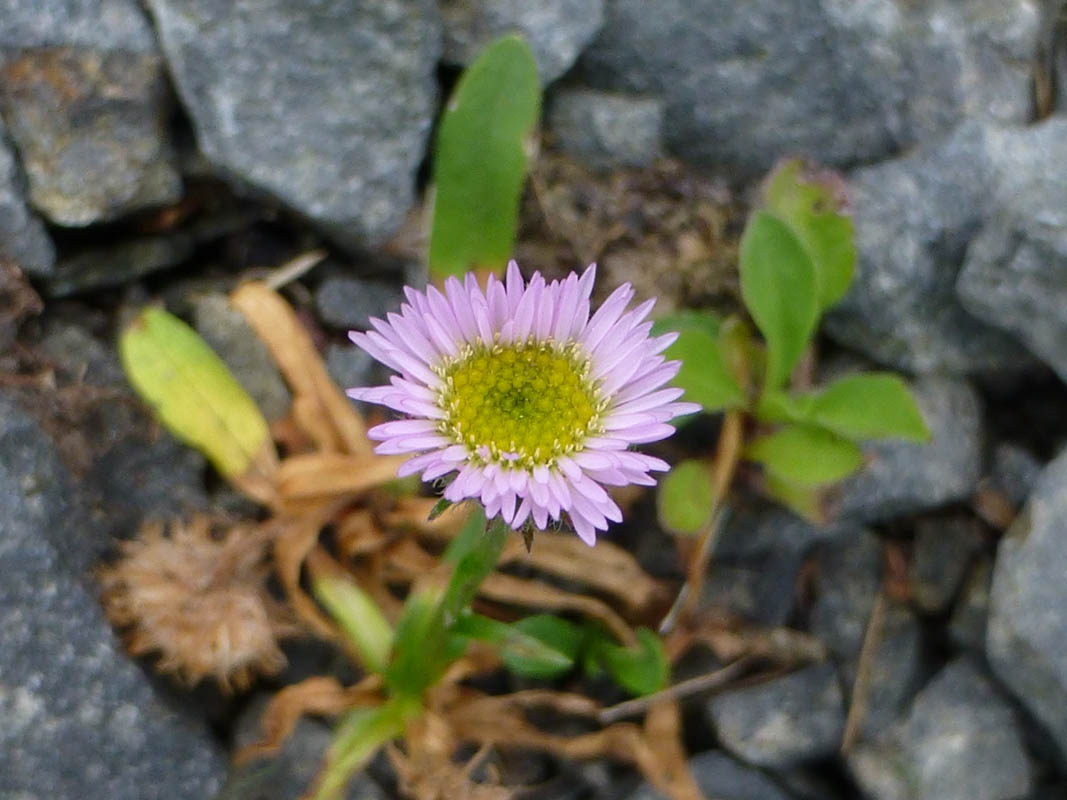
The plant is extremely modest, hardly exceeding 5 to 10 cm in height. It forms a small basal rosette of entire, spatulate, medium green, slightly pubescent leaves. The floral stem, slender and erect, bears a single capitulum, as its name suggests: the ligules are lilac to pinkish-violet, thin and numerous, surrounding a central yellow-green disc at the bud stage, then yellow at maturity.
In its natural habitat, its flowering extends from July to August depending on altitude and snow cover. In cultivation in the plains, it can bloom as early as June.
The strictly unifloral character, the lilac capitulum almost lying on the ground in the gravel, and the slightly reflexed ligules at the end of flowering are easily observable details that distinguish this species from other alpine fleabanes.
In cultivation, it requires a very well-drained, lean soil, in full light, and protection against excessive winter humidity. It thrives in an alpine trough or in a reconstructed mountain rock garden.