syn. Erigeron pyrenaicus
syn. Erigeron pyrenaicus
Perennial of the Asteraceae family, this high-altitude fleabane is widespread in the mountain ranges of Europe: Alps, Pyrenees, Apennines, Carpathians, where it grows between 1,500 and 3,000 meters altitude. It colonizes rock cracks, stabilized screes, and rocky lawns on various substrates, both siliceous and calcareous.
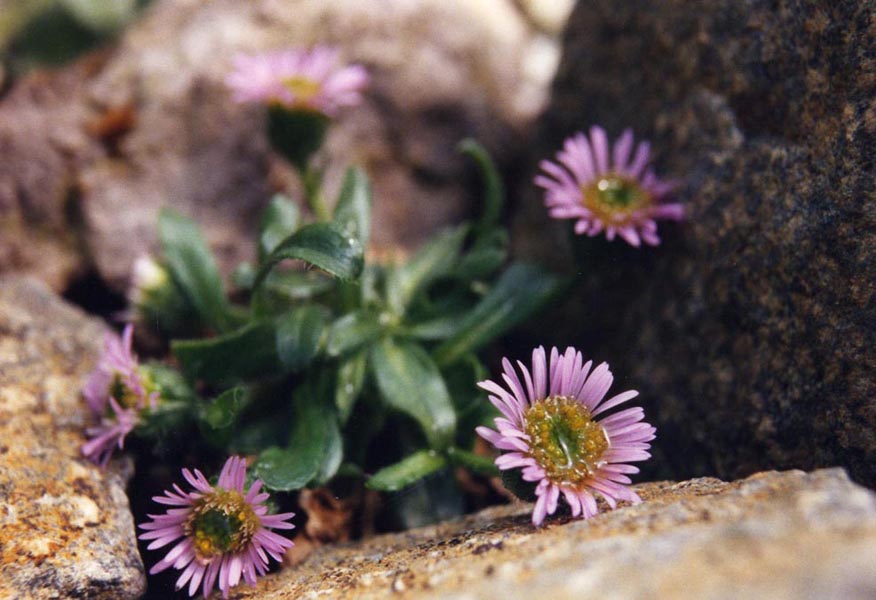
The plant is remarkably dwarf: it hardly exceeds 3 to 8 cm in height, forming tiny rosettes flattened against the rock, with spatulate, slightly hairy leaves, of a fairly deep green. The solitary capitula are carried by stems so short that they seem almost placed directly on the foliage. The narrow and numerous ligules radiate around a yellow-green central disc; their color varies according to individuals, from lilac pink to pure white, the latter shade being found particularly in some high-altitude calcareous populations. This chromatic variability is one of the most striking features of the species observed in the field.
In its natural habitat, its flowering extends from July to September depending on the altitude. In rock garden cultivation, it occurs from June to August.
It requires a very well-drained, poor soil, in full sun, and readily settles in the interstices and cracks of a rock garden. It fears stagnant winter humidity much more than cold, and can spontaneously reseed itself among the stones.