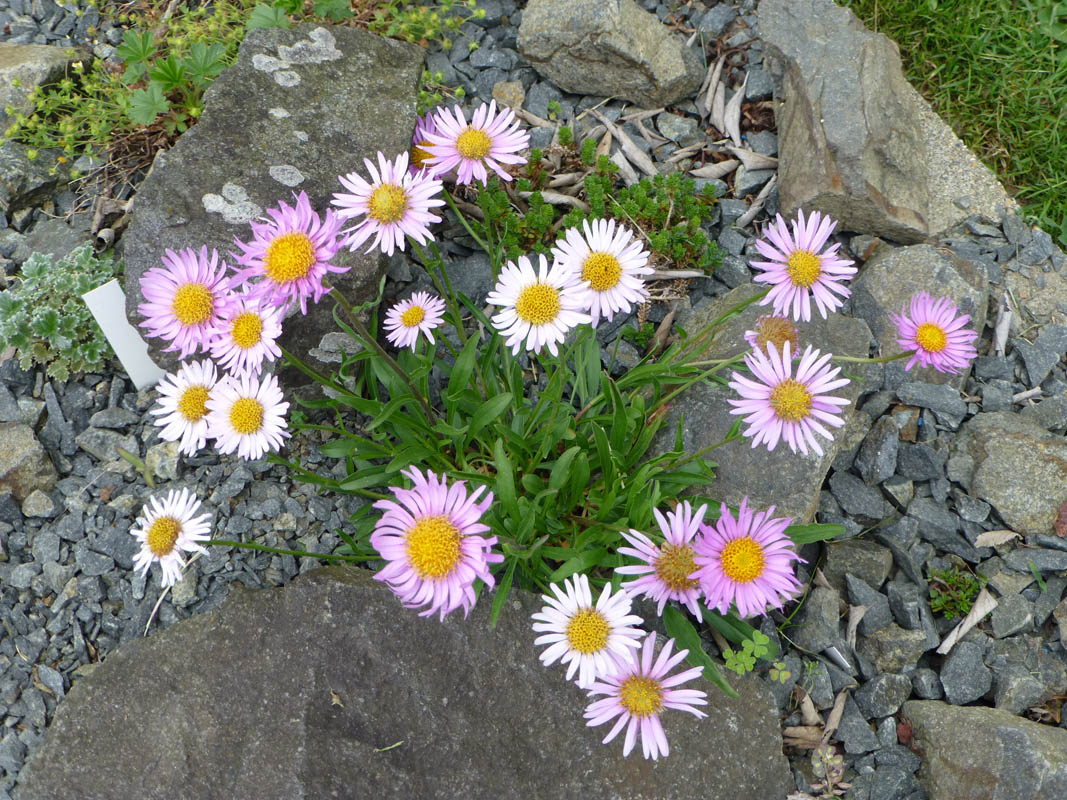
Perennial of the Asteraceae family, this fleabane is native to the mountains of Central and Southern Europe — Alps, Apennines, Carpathians, and Balkans — where it occupies alpine lawns, stabilized screes, rocky ridges, and grassy ledges, generally between 1,500 and 2,800 meters in altitude.
It forms upright and rather loose clumps, 15 to 35 cm in height, bearing sparsely branched stems. The leaves are lanceolate to spatulate, a bright and shiny green, practically glabrous — which its epithet directly recalls — distinguishing it clearly from neighboring species with grayish or hairy foliage. The cauline leaves slightly clasp the stem.
The capitula, solitary or in small numbers per stem, are well open, bearing numerous narrow pink-lilac to pale violet ligules, sometimes almost white at the base, around a bright yellow disc. The flower buds, tinged with pink-violet, are also ornamental before anthesis.
In its natural habitat, its flowering extends from July to August. In cultivation, it generally occurs in June-July depending on altitude and exposure.
It is cultivated in full sun in a well-drained substrate, moderately rich, fresh without excess stagnant moisture. Hardy and undemanding, it is suitable for medium-sized rock gardens and compositions with a natural alpine character.