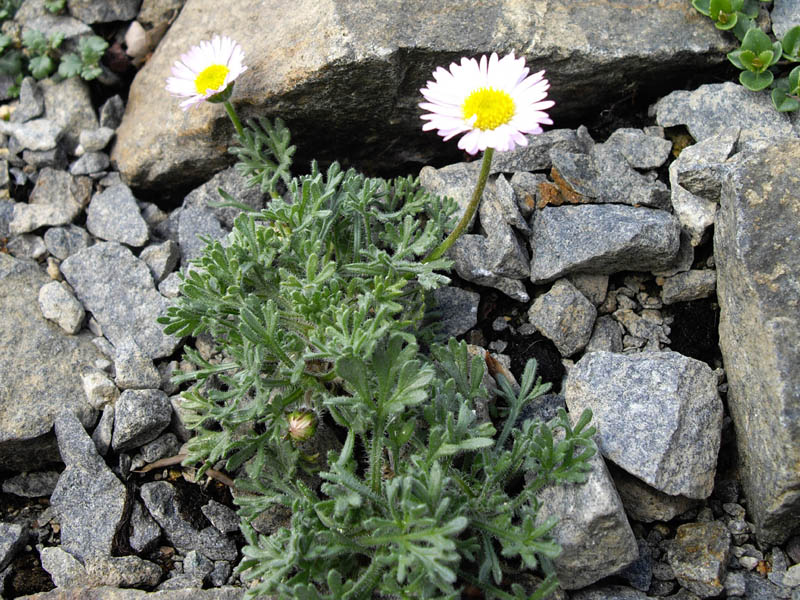
Perennial of the Asteraceae family, native to the western part of North America, from the Rockies to the Pacific coast, where it colonizes scree, rocky ridges, and gravelly slopes at high altitudes, often above 2,000 meters. It favors very well-drained, poor substrates, exposed to full sun.
It forms small, low, dense clumps, 5 to 15 cm in height. Its foliage is one of its most distinctive features: the leaves are deeply cut into narrow segments, divided two to three times, covered with a dense grayish down that gives them a soft texture and a very recognizable silvery appearance. This finely chiseled foliage contrasts sharply with that of other fleabanes. The capitula, borne singly on slender stems barely rising above the foliage, display numerous narrow ligules, pinkish-white to pale pink, around a bright yellow disc.
In its natural habitat, its flowering extends from June to August depending on the altitude. In cultivation, it generally blooms from May to July.
It requires impeccable drainage, a sunny location, and poor soil; it is drought and cold resistant but does not tolerate prolonged winter humidity. Ideal in rock crevices or troughs.