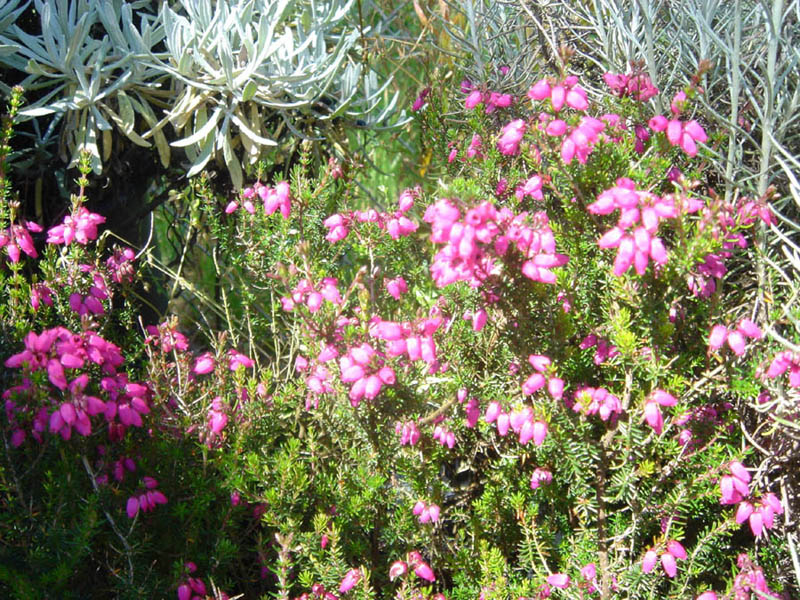
An evergreen shrub of the Ericaceae family, bell heather is native to Atlantic and sub-Atlantic Europe, from the British Isles and Ireland to the Iberian Peninsula, France and north-western Italy. It colonises open heathlands, siliceous rocky slopes, cliff edges and clearings on acid, well-drained soils, from sea level up to approximately 1,000 metres altitude.
It forms a dense, branching subshrub, 20 to 60 cm tall, with reddish-brown woody stems. The leaves are very small, linear and arranged in whorls of three, dark green and glossy — a feature that clearly distinguishes it from Erica tetralix, whose foliage is greyish and tomentose. The urn-shaped flowers are bright pink to magenta-purple, clustered in dense terminal racemes along the current year's shoots. Depending on the cultivar, colour ranges from pure white to lilac-pink and deep carmine. When covering large areas in full bloom, it quite literally tinges exposed hillsides an intense magenta-pink — a sight characteristic of Atlantic heathlands in summer.
In its natural habitat, it flowers from June to September. In cultivation, the flowering period is much the same, with variations depending on exposure and cultivar.
It requires acid, poor, very well-drained soil and full sun; it tolerates neither lime, nor waterlogging, nor shade. Hardy to approximately -15°C, it withstands summer drought better than most other European heathers. A light trim after flowering maintains a compact habit and delays the ageing of the clumps.