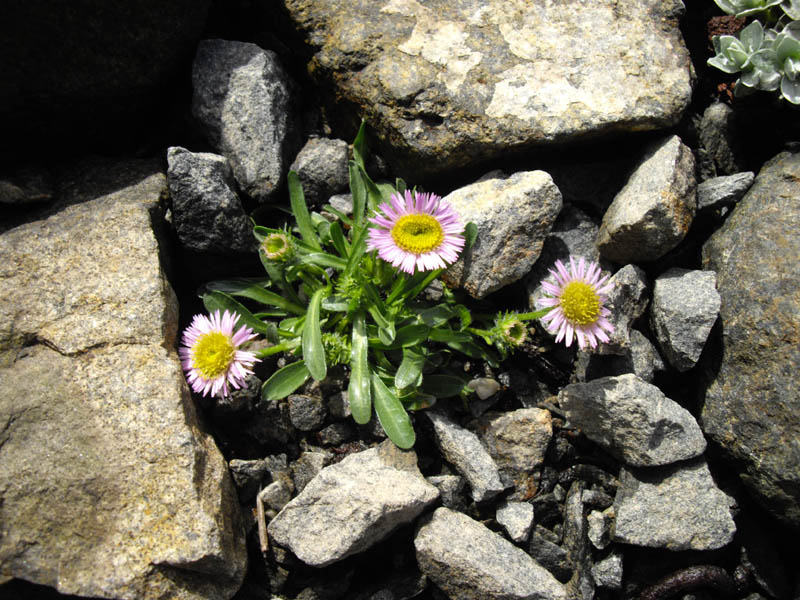
Perennial of the Asteraceae family, this fleabane is native to the western part of North America, from the Great Plains to the foothills of the Rockies, where it grows in screes, dry rocky slopes, and arid meadows, on well-drained substrates, often calcareous or clayey.
It forms very compact small tufts, generally 5 to 15 cm in height, but can remain well below in dry and sunny conditions. The leaves are spatulate to oblong, covered with a fine grayish down that gives them a characteristic ashy appearance. The flower heads, borne solitary at the top of very short stems, have thin and numerous ligules, from pale lilac pink to almost white, around a bright yellow central disc. This extremely low habit, which barely allows the flowers to emerge above the stones, is precisely what the plant expresses in draining and very exposed rockeries.
In its natural habitat, its flowering extends from May to July depending on altitude and latitude. In rockery cultivation, it generally blooms from June to August.
It requires perfect drainage and full sun, withstands summer drought well, and above all dreads stagnant moisture in winter. It ideally settles in the crevices of a rockery or between flat stones, where cultural stress further accentuates its dwarf and compact character.