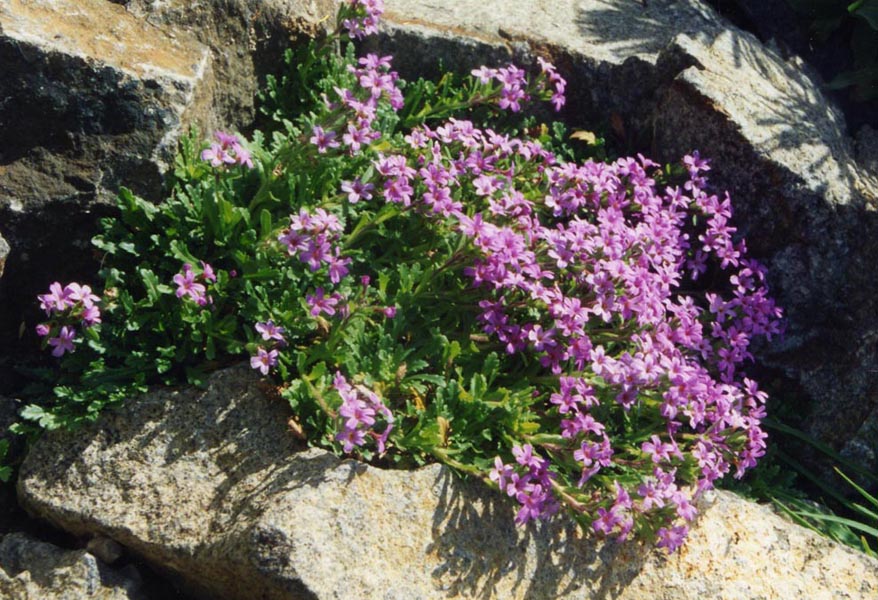
Erinus alpinus
Short-lived perennial, sometimes treated as biennial, from the Plantaginaceae family, Erinus alpinus is native to the mountains of Western and Central Europe: Alps, Pyrenees, Northern Apennines, and Moroccan Atlas. It occupies rock crevices, old walls, limestone screes, and sunny rocky slopes, generally between 800 and 2,400 meters.
It forms low, spreading clumps, 5 to 15 cm in height, adorned with small, spatulate leaves, slightly toothed and pubescent, of a bright green. The numerous flowering stems bear clusters of small flowers with five notched petals, from bright pink to deep pink-lilac, which literally cover the foliage at the time of full bloom.
In its natural habitat, its flowering extends from May to July depending on the altitude. In cultivation on the plains, it often begins as early as April and can partially rebloom in the fall if conditions are favorable.
Its ability to spontaneously establish itself in the joints of old limestone walls, where it freely reseeds, is one of its most remarkable behaviors in the garden. It naturalizes with disconcerting ease as soon as the substrate is well-drained and limestone is present.
It prefers a sunny exposure, poor and perfectly drained soil, preferably limestone. Easy to grow in rock gardens, walls, or alpine troughs, it multiplies easily by sowing.