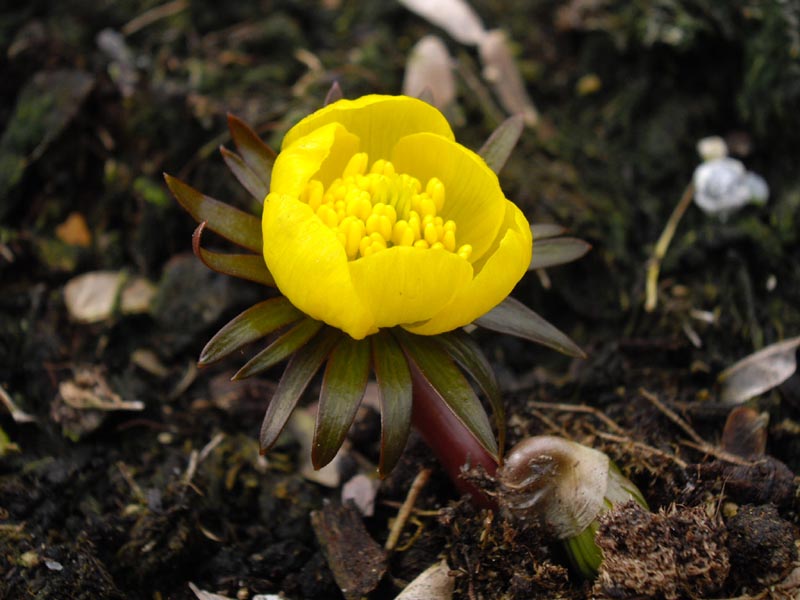
Tuberous perennial of the Ranunculaceae family, the winter aconite is native to southeastern Europe, from the Balkans to Italy and southern France, where it grows in cool and damp deciduous undergrowth, shaded paths, and forest edges on calcareous or neutral soils.
It is one of the earliest plants of the temperate flora: its flowers appear as early as January-February, often alongside snowdrops, even before the leaves are fully developed. Each short stem, 5 to 10 cm, bears a single bright yellow, cup-shaped flower, surrounded by a collar of finely cut green bracts that gives it an immediately recognizable characteristic appearance. This collar, often mistaken for foliage, is actually a floral structure distinct from the basal leaves, which only appear after flowering.
In its natural habitat, its flowering extends from January to March depending on altitude and exposure. In cultivation, it is the same, often from the first weeks of the year.
It readily naturalizes under deciduous trees, forming over time large, very bright golden carpets in the heart of winter. It prefers a cool, well-drained soil in summer, rich in humus, in partial shade or light cover. The tubers transplant better fresh, just after flowering, rather than dry.