syn. Zauschneria cana
syn. Zauschneria cana
A suffrutescent perennial of the Onagraceae family, Epilobium canum ssp. canum is native to California and northwestern Mexico, where it grows in dry rocky slopes, coastal garrigues, and chaparral-covered hillsides in full sun, at low and mid-altitudes. It is one of the few species in the genus with a distinctly bushy habit and bright red flowering.
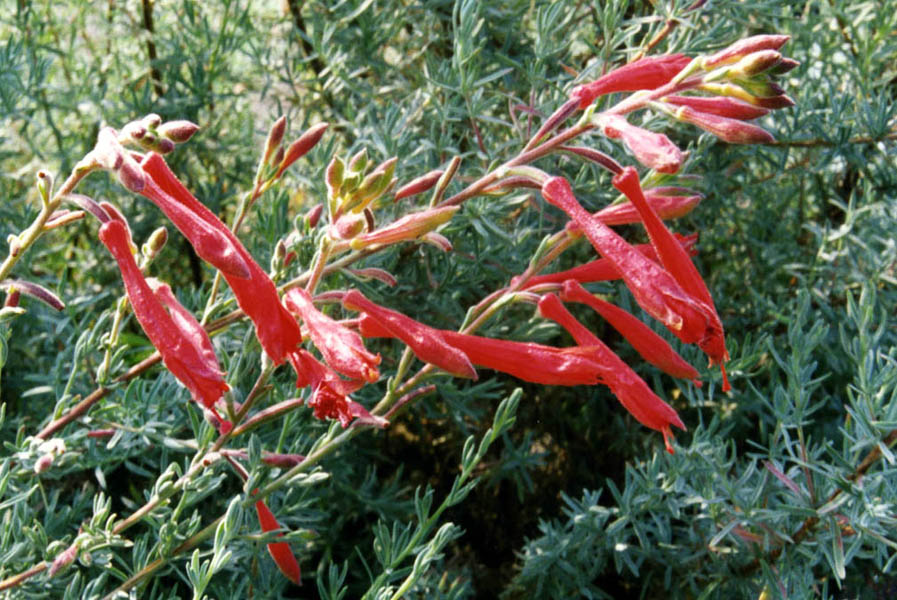
It forms a dense, rounded bush 40 to 80 cm tall, with many upright and branched stems, densely covered with small, narrow, lanceolate leaves, of a slightly tomentose ash-green, giving it a soft texture and a very characteristic silvery appearance, visible even from a distance.
The flowers are tubular, elongated, of an intense scarlet red, borne in large numbers at the ends of the branches. Their narrow tube shape is an adaptation to pollination by hummingbirds in their native range. The overall effect, hundreds of small bright red tubes set against gray foliage, is particularly striking in full bloom.
In its natural habitat, its flowering extends from July to October. In cultivation under temperate climates, it generally occurs from August to October, making it one of the latest perennials in the rock garden.
It requires full sun, a very well-drained soil, dry to moderately fresh in summer, and a sheltered exposure in climates with harsh winters, as its hardiness is limited to regions with moderate frost. Perfect drainage in winter is essential for its longevity.