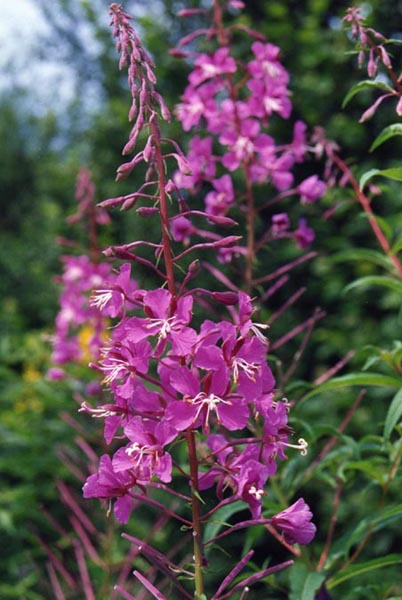
(Epilobium angustifolium)
(Epilobium angustifolium)
A perennial of the Onagraceae family, Chamerion angustifolium is a circumboreal species with a very wide distribution, present throughout Europe, Asia, and North America, where it colonizes forest clearings, edges, embankments, screes, and especially disturbed or burned areas. In the mountains, it rises up to about 2,500 meters, where it sometimes forms vast populations in tall herb communities and high vegetation hollows.
It grows in upright and vigorous stems, 60 to 150 cm high, bearing alternate, lanceolate, narrow leaves, medium green on top and slightly glaucous underneath, with secondary veins that loop before reaching the edge — a distinctive feature observable with a magnifying glass. The stems, often reddish, stand in dense colonies via rhizomes.
The inflorescence is a long terminal spike that can group several dozen flowers with four rounded petals, bright pink to magenta-pink, opening progressively from bottom to top. The stamens and the long curved style are clearly visible. It is highly visited by bees, which make a renowned honey from it in Nordic countries and Russia, where the plant is known as "Ivan-tea" and has long been used to prepare a fermented herbal tea.
In its natural habitat, its flowering extends from July to September depending on the altitude.
In cultivation, it is undemanding but very vigorous: its spread by rhizomes can become invasive in an ordinary garden. It is better suited to large natural compositions, banks, or wild-style gardens, in fresh and well-sunny soil.