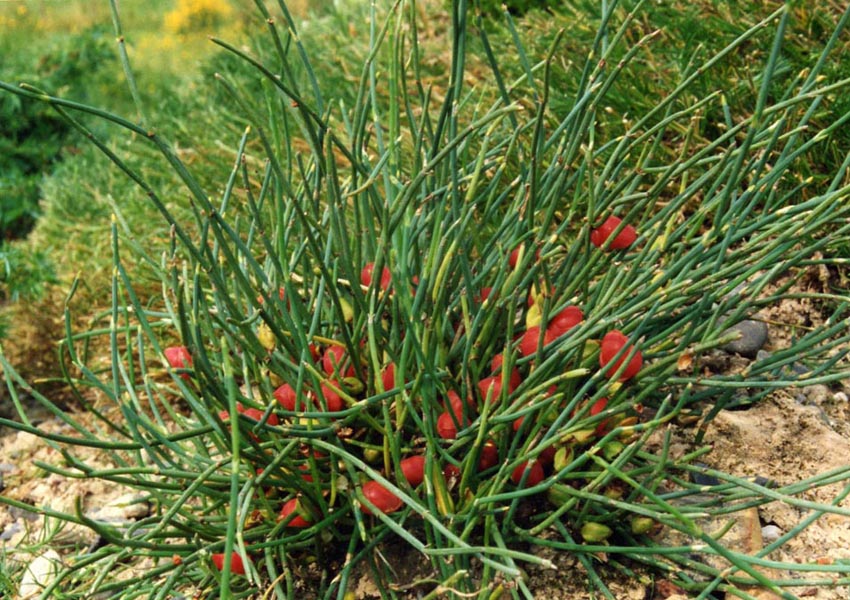
Gymnosperm of the Ephedraceae family, Ephedra minima is endemic to the Pyrenees and the north of the Iberian Peninsula, where it colonizes rocky grasslands, limestone screes, and wind-exposed sunny ridges, generally between 1,200 and 2,400 meters. It is the smallest European species of the genus.
It forms a very compact and rounded small bush, only 5 to 15 cm in height, composed of jointed, cylindrical stems, bright green to gray-green, completely devoid of visible leaves, reduced to tiny scales at the nodes. This strictly leafless, almost mineral habit gives it a singular silhouette, halfway between a vascular plant and a garrigue shrub, immediately recognizable in high-altitude grasslands.
Fruiting is its most spectacular moment: the mature female cones transform into small fleshy structures of a bright vivid red, oval, grouped in numbers at the heart of the bush, strikingly contrasting with the green of the stems. This is not strictly speaking a flowering in the usual sense, but the summer fruiting, from July to August, constitutes the main ornament of the plant.
In cultivation, it requires absolute full sun, a very well-drained, calcareous or poor mineral soil, and perfectly tolerates drought. Totally hardy in Pyrenean conditions, it is undemanding once established and constitutes a first-rate botanical curiosity for the alpine rock garden.