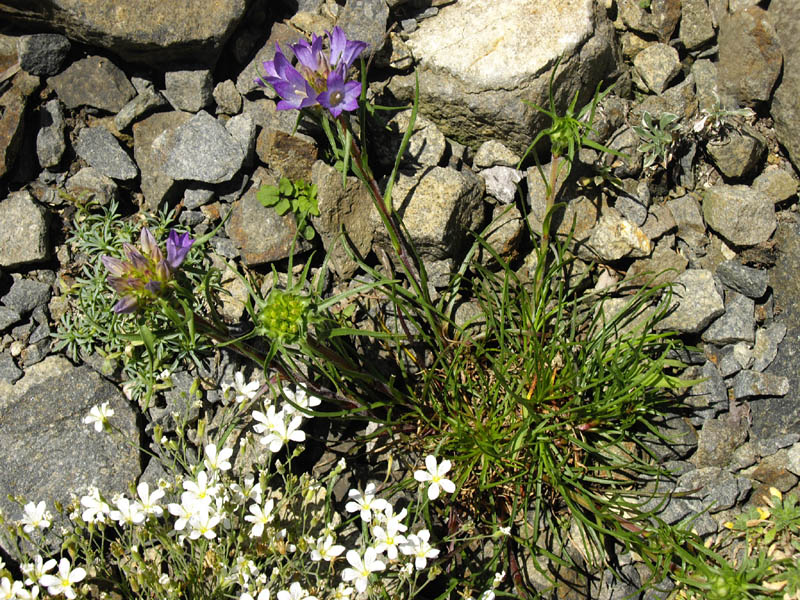
A perennial from the Campanulaceae family, Edraianthus tenuifolius is native to the Balkans, mainly the Italian peninsula, Croatia, and Adriatic regions, where it colonizes scree, cracks in limestone rocks, and dry rocky lawns, between approximately 500 and 1,800 meters.
It forms a low and loose tuft, 10 to 20 cm in height, with very narrow, linear, almost filiform leaves, of a bright green, slightly ciliated on the edges. This thin and flexible foliage, which gives it its epithet, gives it a more airy and less rigid appearance than its close cousins. The upright flowering stems bear at their top a compact head of grouped bell-shaped flowers, surrounded by well-visible pointed bracts.
The flowers are an intense violet-blue to violet-purple, with widely spread lobes, of a clear and bright color that stands out remarkably on the gray limestone scree where the plant naturally settles.
In its natural habitat, its flowering extends from June to July. In cultivation, it generally occurs in June.
Like the entire genus, it requires full sun, rigorous drainage, and poor calcareous soil. It tolerates better than Edraianthus pumilio a certain lightness of the substrate, but remains sensitive to any prolonged moisture during the resting period. A good rock garden plant for those who can offer it the summer dryness it appreciates.