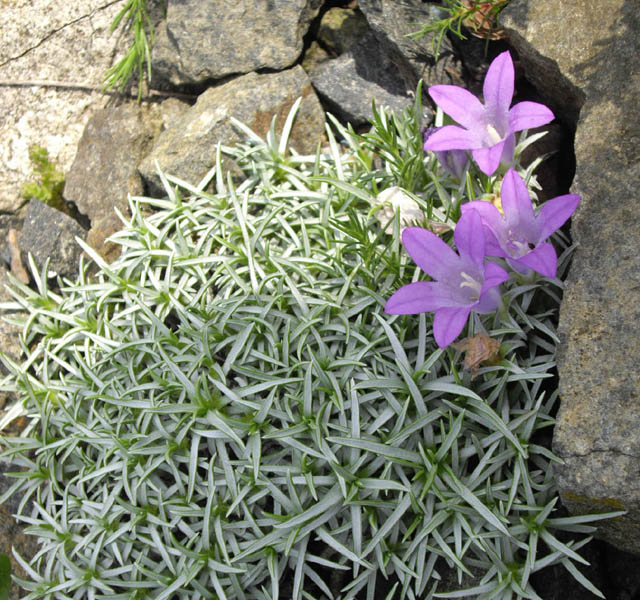
Perennial of the Campanulaceae family, Edraianthus pumilio is endemic to the Balkans, mainly the mountains of Croatia and Montenegro, where it settles in the cracks of limestone rocks and exposed screes, between 1,000 and 2,000 meters in altitude. It is one of the smallest and most compact species of the genus.
It forms a very tight cushion, almost hemispherical, only 3 to 6 cm in height, composed of rosettes of linear, narrow leaves, densely covered with a silvery-whitish tomentum that gives the whole a frosted appearance, luminous even without flowers. This silvery foliage alone constitutes a permanent attraction in the rock garden.
The flowers, solitary, sessile or almost, emerge directly from the cushion without visible stem, bell-shaped with spreading lobes, of a light violet-mauve to pinkish lilac. Their size, relatively large compared to the plant, accentuates the striking contrast between the silvery cushion and the flower placed on top as if deposited there.
In its natural habitat, its flowering extends from June to July. In cultivation, it generally occurs in May-June.
It requires absolute drainage, a lean limestone substrate, and uncompromising full sun. The slightest stagnant moisture in winter is fatal to it. Planting in a vertical crack or on a very mineral substrate suits it ideally. It is a plant for informed collectors, demanding but of sober and precise beauty.