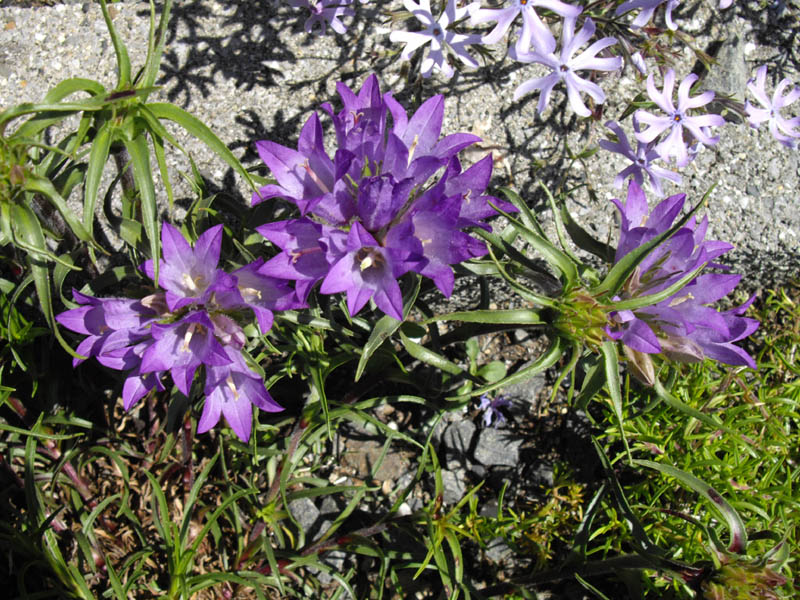
A perennial of the Campanulaceae family, Edraianthus graminifolius is native to the Balkans and the Italian peninsula, where it grows in the cracks of limestone rocks, scree, and rocky high-altitude grasslands, generally between 500 and 2,000 meters. It is a typically Mediterranean-mountainous plant.
It forms small loose tufts of linear, narrow leaves that are slightly ciliated on the edges, of a medium green, which indeed evoke a grassy foliage — hence its epithet. The upright flowering stems, 10 to 20 cm tall, bear at their top compact heads of bell-shaped flowers, tightly packed together and framed by pointed leafy bracts that give them a very characteristic radiant appearance.
The flowers are of an intense violet to bright violet-purple, with star-spread lobes, a rare color boldness in the rock garden. This dense terminal grouping, half-bouquet half-hedgehog, is the most immediately recognizable feature of the genus Edraianthus.
In its natural habitat, its flowering extends from May to July depending on altitude. In cultivation, it generally occurs in June.
It requires full sun, perfect drainage, and poor calcareous soil. It withstands summer drought well once established, but absolutely fears stagnant winter moisture. Planting on a slope or in a wall crack suits it perfectly.