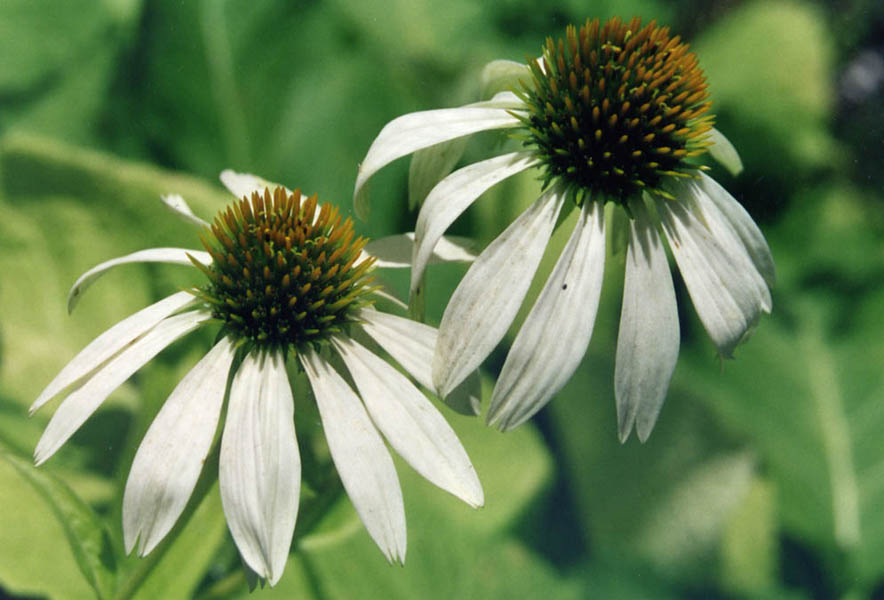
A perennial from the Asteraceae family, Echinacea purpurea is native to the eastern and central parts of North America, where it grows in open meadows, light forest edges, and well-drained grassy areas. The 'Alba' cultivar is a white-flowered selection obtained through horticultural cultivation.
The plant forms an upright and vigorous clump, reaching 60 to 90 cm in height. The stems are sturdy, slightly bristly, bearing oval to lance-shaped, dark green leaves, rough to the touch — a characteristic shared with the species type.
The flower heads are large, solitary at the top of each stem, composed of cream to pure white ligules, slightly reflexed downward at maturity, framing a hemispherical central cone, orange-brown to golden-brown, bristling with spiky bracts — hence the name Echinacea, from the Greek echinos, the hedgehog. This contrast between the dark cone and the light ligules is particularly striking in this cultivar.
In its natural habitat, the species blooms from July to September. In cultivation, 'Alba' blooms from June to August, sometimes until September. The cones persist after flowering and provide winter interest for seed-eating birds.
It thrives in full sun, in ordinary well-drained soil, tolerating periods of moderate drought once established. It is undemanding and adapts to most large perennial, meadow, or rock gardens.