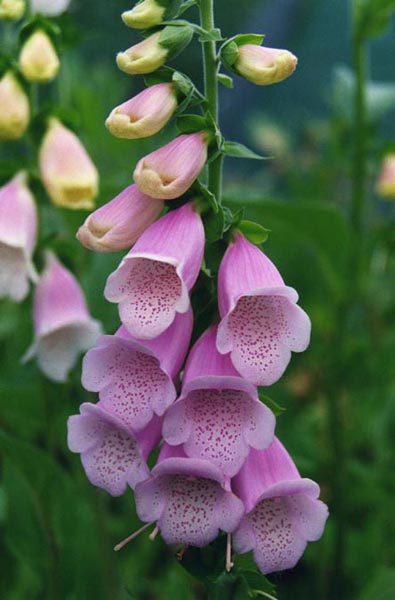
Biennial or short-lived perennial of the Plantaginaceae family, this subspecies is endemic to the southwest of the Iberian Peninsula, mainly in Portugal and Spanish Extremadura, where it grows on rocky slopes, open scrublands, and edges of light forests, on siliceous substrates, at low and medium altitude.
It is distinguished from the type subspecies by remarkably silvery foliage, densely tomentose on both sides, with a bright whitish-gray that gives it an architectural presence even when not in bloom. The stems, also woolly, reach 60 to 100 cm.
The tubular flowers, arranged in a well-stocked unilateral spike, are soft pink to pale lilac-pink, with a slightly lighter throat finely dotted with purple-pink. The flower buds, still wrapped in their woolly and yellowish sepals, add a soft and velvety note to the whole inflorescence.
In its natural habitat, flowering extends from May to July. In cultivation, it generally occurs in May-June.
It requires a very well-drained, dry to fresh, poor soil, in full sun. Its tomentose foliage makes it sensitive to excess winter moisture; protection or a sheltered location is advised in cold and rainy climates. It readily reseeds itself in favorable conditions.