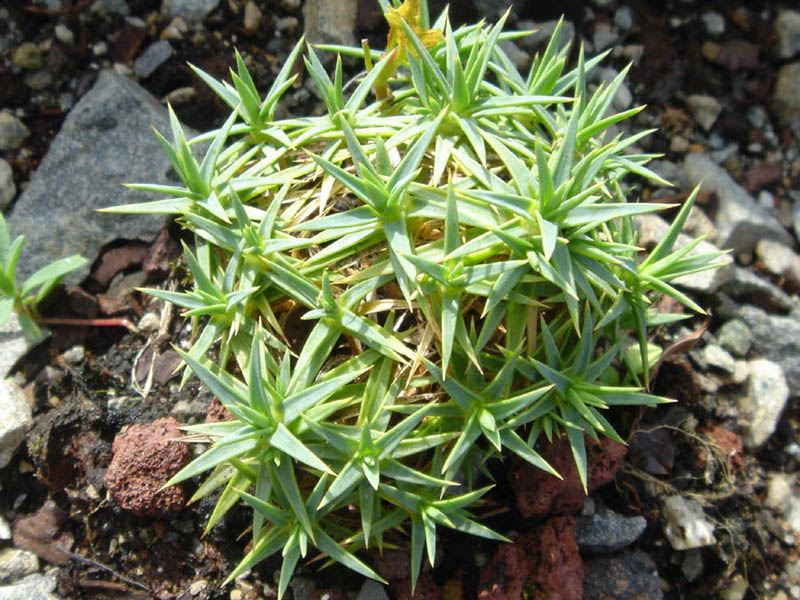
Dianthus webbianus is a perennial from the Caryophyllaceae family, endemic to the Iberian Peninsula, primarily known from the mountains of central and northern Spain, where it occupies rocky areas, scree, and high-altitude grasslands on siliceous substrates, between approximately 1,500 and 2,500 meters.
It forms very dense and rounded cushions, remarkably compact, with short, rigid, mucronate linear leaves, from bright green to dark green, arranged in tight rosettes that give the cushion an almost spiny texture, reminiscent from afar of certain acantholithons. This is one of the most immediately distinctive features of the species, clearly visible outside of flowering.
The flowers, borne just above the cushion on very short stems, are pale pink to lilac pink, with slightly denticulate petals, simple and clean, without deep cuts. They generously dot the surface of the cushion at the time of flowering. In its natural habitat, its flowering extends from June to August. In cultivation, it can begin as early as the end of May.
It requires perfect drainage, a poor substrate, preferably siliceous, and full sun exposure. It tolerates drought and winter cold well. Its cultivation in a container or in a very well-drained rock garden is particularly suitable, where the architectural beauty of the cushion is fully revealed even outside the flowering period.