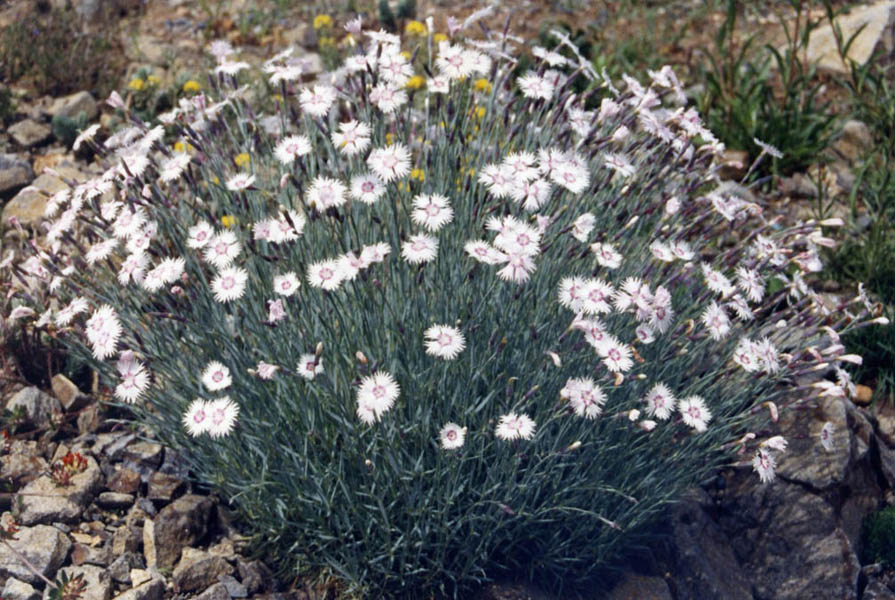
Perennial of the Caryophyllaceae family, Dianthus plumarius is native to Central and Eastern Europe, from the Carpathians to the Balkans, where it naturally grows on limestone rocks, cliffs, screes, and sunny rocky dry lawns, between approximately 200 and 1,800 meters.
It forms dense, well-rounded hemispherical tufts, 20 to 35 cm in height when in bloom, with very pronounced glaucous blue-gray linear evergreen foliage, which retains all its ornamental value outside of flowering. The flowers, borne on upright stems, are white to pale pink, with petals that are broadly and deeply fringed giving that airy aspect evoked by the name plumarius, with a well-defined pink-red central eye that structures each flower. The fragrance is pronounced, sweet, characteristic of the group of fragrant carnations.
In its natural habitat, its flowering extends from May to July. In cultivation, it generally occurs from May to June, with sometimes a slight resurgence after mowing.
Probable ancestor of many garden carnations cultivated since the Middle Ages, it is one of the founding species of European ornamental horticulture. It requires a sunny exposure, well-drained calcareous soil, dry to moderately fresh, and proves very hardy and durable in rock gardens or borders.