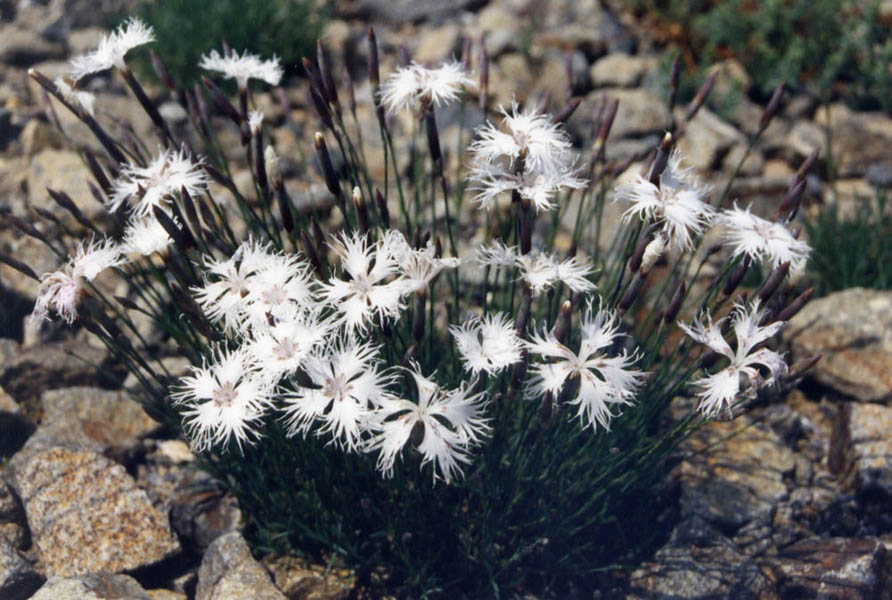
Perennial of the Caryophyllaceae family, Dianthus petraeus is native to the Balkans, where it occupies limestone rockeries, cliffs, and sunny rocky scree, mainly in Romania, Bulgaria, Serbia, and North Macedonia, between 500 and 2,000 meters depending on the subspecies.
It forms compact and dense clumps, 15 to 30 cm in height when in bloom, with very fine, almost needle-like, dark green, persistent foliage. The flower stems, remarkably tinged with dark purple-brown, upright and rigid, constitute in themselves a striking distinctive feature even before the flowers open. These are white, with deeply and abundantly fringed petals, a delicate lacework that gives them an airy and cobweb-like appearance, strongly contrasting with the rigidity of the foliage and the dark color of the stems.
In its natural habitat, its flowering extends from June to August. In cultivation, it generally occurs in June-July, with sometimes a slight resurgence.
It requires full sun exposure, a limestone soil, very well-drained, dry to moderately fresh, and easily tolerates poor and rocky substrates. Perfectly suited to rockeries, walls, and gravel gardens, it displays a flowering of uncommon delicacy in the genus.