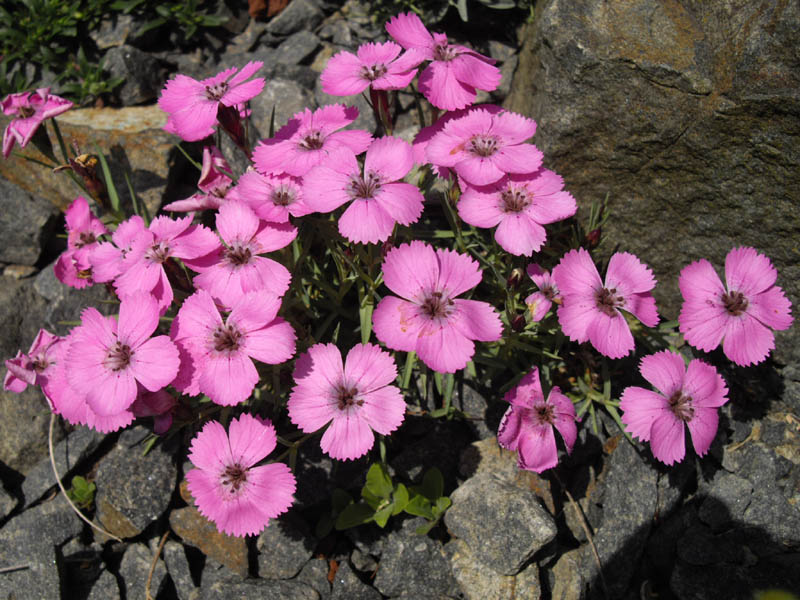
syn. Dianthus neglectus
syn. Dianthus neglectus
Perennial of the Caryophyllaceae family, Dianthus pavonius is an alpine carnation of the southwestern Alps, mainly found in the Maritime, Cottian, and Graian Alps, on the French and Italian sides. It occupies acidophilic lawns, rocky areas, and fine high-altitude scree, generally between 1,500 and 2,800 meters, on siliceous or decalcified substrates, in full light.
It forms dense and low cushions, 5 to 15 cm in height when in bloom, with fine linear foliage, glaucous to greenish-gray. The flowers, borne individually on very short stems, are among the most colorful of the genus in the Alps: bright pink to intense magenta pink, with a well-marked dark purple basal spot at the throat creating a particularly clear contrasting eye. The reverse of the petals is chamois to yellowish-beige, a distinctive feature easily observable when the buds close or in the wind.
In its natural habitat, its flowering extends from July to August depending on the altitude. In cultivation, it generally occurs from June to July.
It requires a fully sunny exposure, a very well-drained, poor soil, preferably acidic to neutral, without active limestone. Demanding on the nature of the substrate, it rewards these care with a remarkably intense colored bloom for a plant of this size.