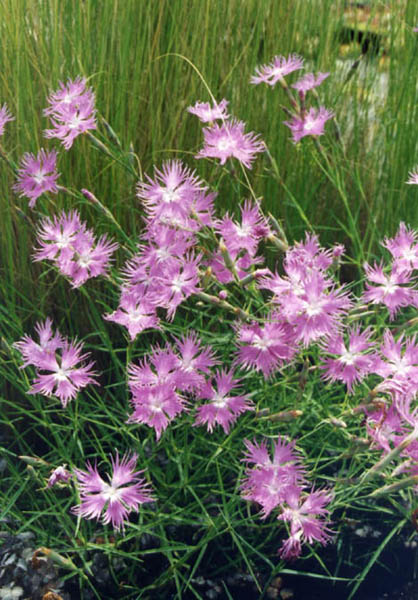
Perennial of the Caryophyllaceae family, Dianthus monspessulanus is found in a large part of central and southern Europe, from the Pyrenees to the Alps, the Apennines, and the Balkans. It grows in dry to fresh meadows, edges of light woods, calcareous lawns, and herbaceous rockeries, from hills up to about 2,000 meters in altitude.
It forms airy bushy clumps, reaching 30 to 50 cm in height, with slender, branched stems bearing fine, medium green linear foliage. Its flowers are among the most cut of the genus: the petals, lilac pink to mauve pink, are laciniated over half or more of their length, creating a corolla of almost ethereal lightness, with a paler whitish center. This deeply chiseled fringe is the most immediately striking feature of the species, which stands out distinctly in this respect from most other European carnations.
In its natural habitat, its flowering extends from June to August. In cultivation, it generally occurs from June to July, with sometimes a partial resurgence.
It appreciates a sunny to lightly shaded exposure, well-drained soil, moderately rich, preferably calcareous. Hardy and undemanding, it readily reseeds itself and naturally combines with bellflowers, as shown by several associations observed in cultivation.