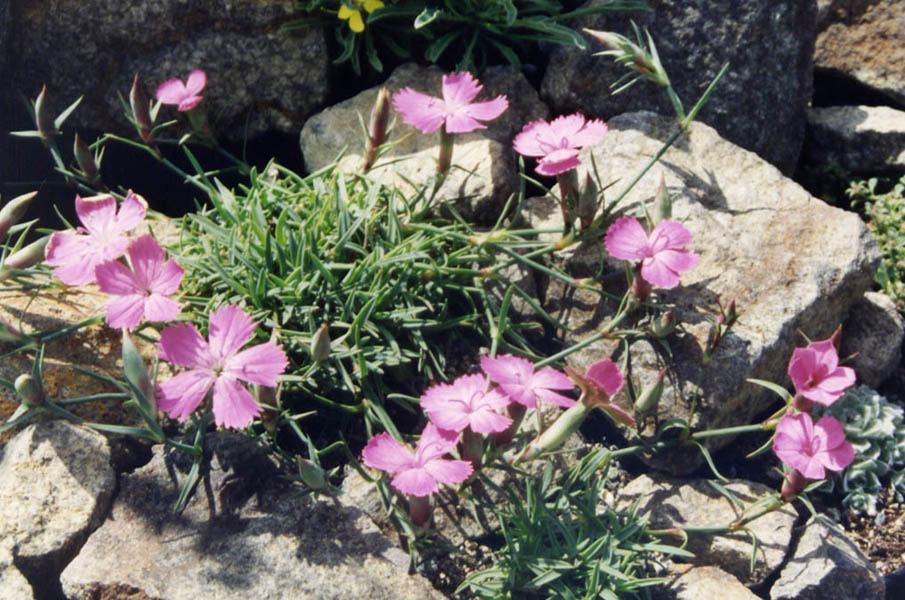
Perennial of the Caryophyllaceae family, Dianthus haematocalyx is native to the Balkans, mainly Greece where it appears in five subspecies, but also Albania and North Macedonia. It grows on rocks, scree, and dry mountain lawns, on well-drained mineral substrate, preferably limestone, between approximately 1,000 and 2,400 meters.
It forms low tufts about 10 cm high, with linear grayish-green to slightly glaucous foliage, persistent. The flowering stems are slender and prostrate, spreading between the rocks rather than standing upright, giving it a naturally creeping habit, well-suited to rock crevices. Its most distinctive feature remains its blood-red to deep red-brown calyx, which sharply contrasts with the bright pink petals of the open flowers and remains decorative well after anthesis.
In its natural habitat, its flowering extends from June to August depending on altitude. In cultivation, it generally occurs from June to July.
It requires a sunny exposure, a very well-drained mineral soil, slightly calcareous, and protection against stagnant winter moisture. A melliferous plant, it attracts pollinators during its summer bloom.