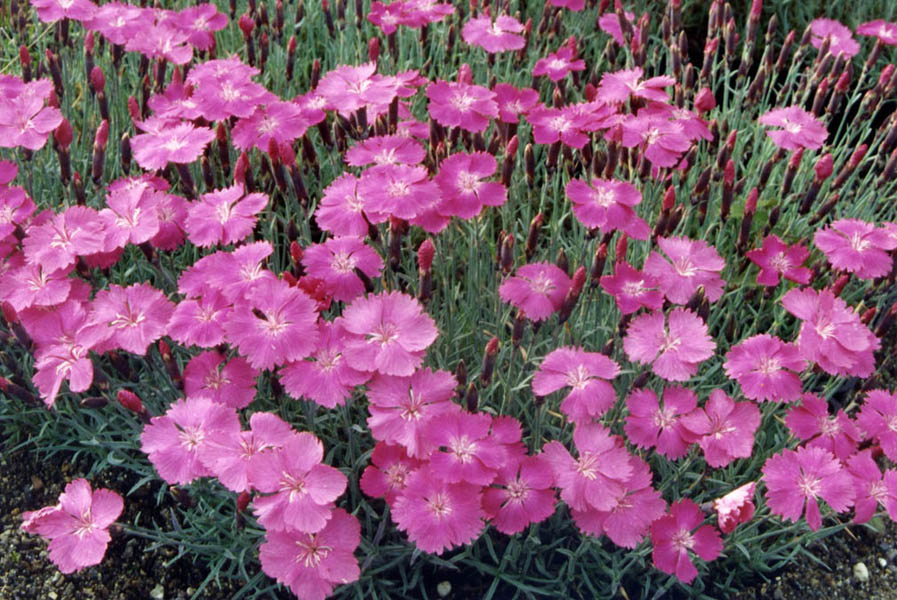
A perennial from the Caryophyllaceae family, the Grenoble pink is native to central and western Europe, the limestone massifs of the Jura, the Ardennes, the Massif Central, and the northern Alps, where it colonizes sunny rocks, cliffs, and dry lawns on limestone substrate, between approximately 300 and 1,500 meters.
It forms dense and spreading cushions, 10 to 20 cm in height, with linear and glaucous evergreen foliage, a characteristic blue-green that remains decorative outside of flowering. The flowers, solitary at the top of short and firm stems, are bright pink to fuchsia pink, with widely spread petals distinctly fringed on their margin, with a slight sweet fragrance perceptible in warm weather. The flower buds, dark burgundy red before anthesis, sharply contrast with the glaucous foliage and the open flowers, creating a very lively contrast effect on the tuft in full bloom.
In its natural habitat, its flowering extends from May to July. In cultivation, it occurs from May to June, sometimes with a slight resurgence in autumn.
Hardy and accommodating, it adapts well to rock gardens, walls, and sunny borders, provided with well-drained soil, preferably limestone, and full sun exposure. It withstands summer drought and is one of the most reliable and generous rock garden species of the genus.