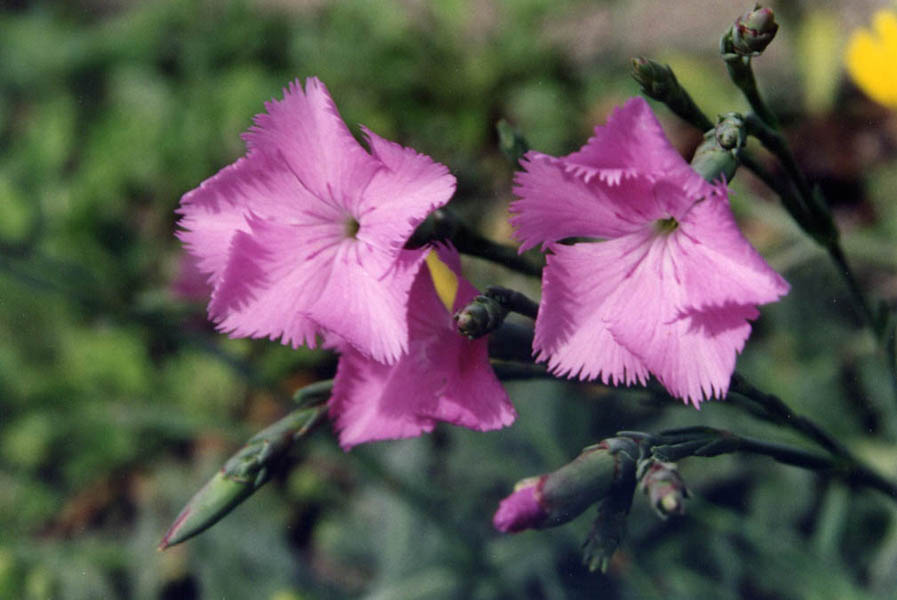
Perennial of the Caryophyllaceae family, Dianthus gallicus is a strictly coastal carnation, endemic to the Atlantic coasts of Western Europe: French Atlantic facade, Iberian Peninsula, and Channel Islands. It is confined to fixed or semi-fixed dunes and maritime sands, where it grows in full light, at ground level or among marram grass, just a few meters from sea level.
The plant forms an upright to slightly spreading tuft, 20 to 40 cm in height, with slender stems bearing narrow, linear, glaucous foliage, adapted to drought and sea spray. The flowers, borne in small loose groups at the top of the stems, are bright pink to lilac pink, relatively large for a wild carnation, with petals widely spread and distinctly fringed at their edge, an immediately visible and distinctive feature. Their slight scent is noticeable in warm weather.
In its natural habitat, its flowering extends from June to August. In cultivation, it is roughly the same.
A protected species in France, where its dune habitats are threatened by tourist activity and dune stabilization. In cultivation, it requires a sandy, very well-drained, poor soil, in a fully sunny exposure; it tolerates salt and drought but fears heavy and wet soils in winter. A rare and precious species, emblematic of wild Atlantic coastlines.