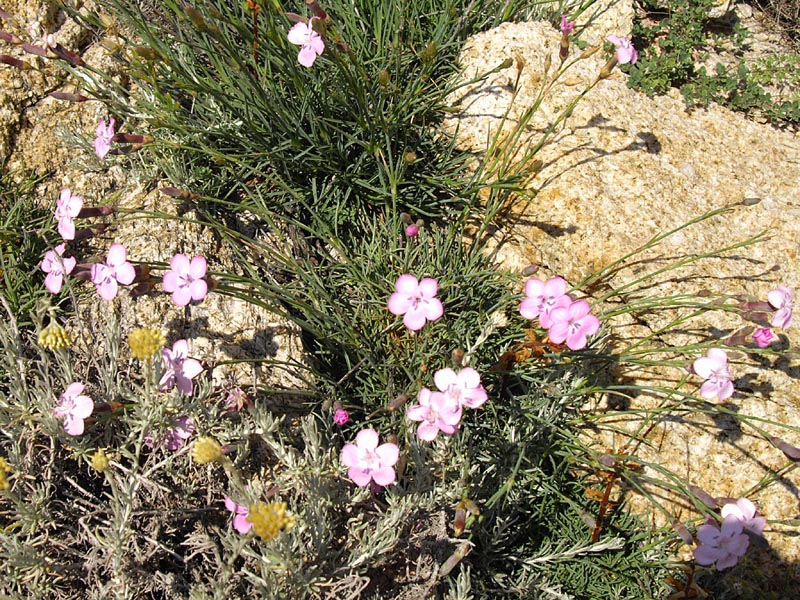
- photographed in Corsica -
- photographed in Corsica -
Perennial of the Caryophyllaceae family, Dianthus furcatus subsp. gyspergerae is a subspecies endemic to the Franco-Italian Maritime Alps, where it colonizes rocks, crevices, and rocky lawns on siliceous or crystalline substrate, between approximately 1,000 and 2,200 meters in altitude. It is considered a rare and localized taxon, linked to the crystalline massifs of this alpine sector.
The plant forms a loose bushy clump, 15 to 35 cm in height, with slender stems branching from the base, bearing very narrow, linear, green to green-gray foliage. The flowers, borne singly at the top of long, thin, forked stems, are pure white or pale pink depending on the individuals, with well-spread petals, entire or very slightly wavy, of great elegant simplicity. This color variability within the same population is one of the observable characteristics of the subspecies.
In its natural habitat, its flowering extends from July to August. In cultivation, it generally occurs from June to August depending on altitude and exposure.
It requires well-drained, acidic to neutral, poor soil, in full light. Unlike many Dianthus that prefer limestone, this subspecies is strictly linked to siliceous substrates, which guides cultivation choices: granite rockery, acidic sandy soil, or trough with a substrate without limestone. A discreet but precious plant for collectors attached to alpine endemics.