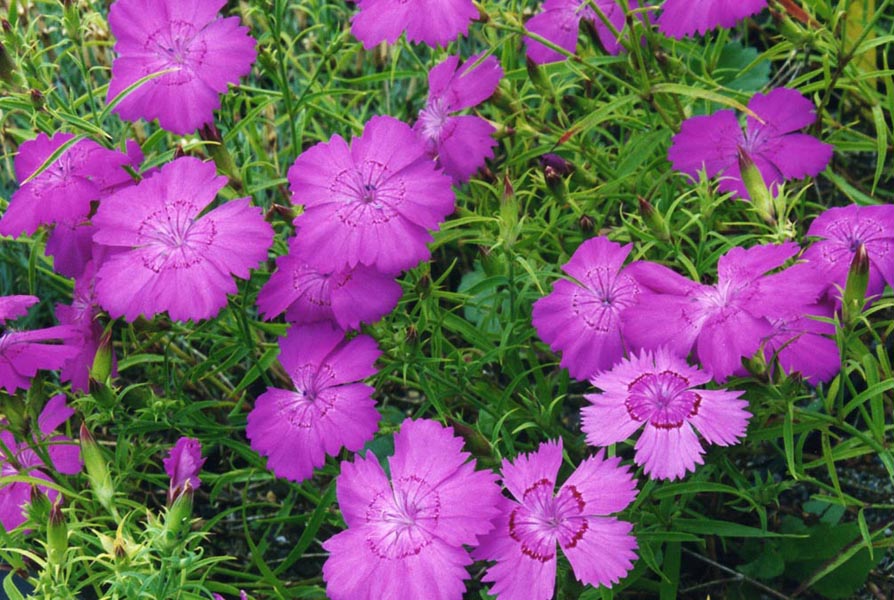
A perennial from the Caryophyllaceae family, Dianthus chinensis is native to East Asia, from northern China to Amur Siberia, Korea, and Japan. It naturally grows in dry meadows, grassy edges, and sunny rocky slopes, at low and medium altitudes.
The plant forms loose and spreading clumps, 20 to 40 cm in height, with linear-lanceolate foliage, medium to bright green, supple and dense. The flowering stems are slender, branched, bearing solitary or few grouped flowers. The petals are widely spread, with finely toothed edges, in a bright pink to intense pink-violet, sometimes almost magenta, with a darker central eye, pink-purple to burgundy red, from which fine veins radiate across the entire surface of the limb. This veined network, visible to the naked eye, gives the flowers a particularly luminous radiant appearance.
In its natural habitat, its flowering extends from June to August. In cultivation, it can start as early as May and continue until September if conditions are favorable.
It appreciates well-drained soil, even poor, in full sun exposure. Tolerant of quite cold winters thanks to its Siberian origin, it is hardier than its name chinensis might suggest. It is suitable for borders, rock gardens, and sunny embankments, where its floral abundance produces a colorful and natural mass effect.