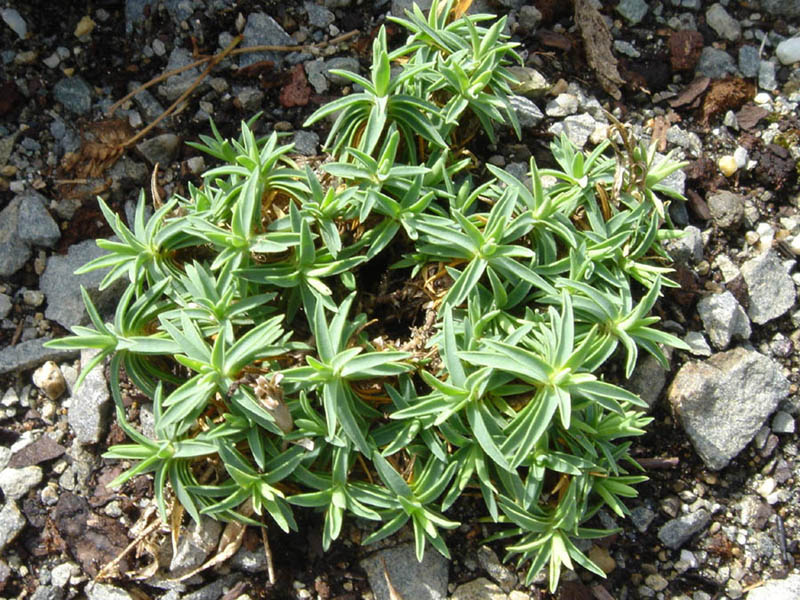
Perennial of the Caryophyllaceae family, Dianthus callizonus is an endemic species of the Romanian Carpathians, confined to a few limestone massifs of Transylvania, notably in the Piatra Craiului. It occupies rock crevices and rocky grasslands exposed to the sun, between approximately 1,500 and 2,200 meters in altitude. Its extremely restricted range makes it a rare and protected species in its natural habitat.
The plant forms small dense cushions, composed of numerous closely joined star-shaped rosettes, 5 to 15 cm in height. The leaves are narrowly linear, slightly widened at the base, arranged in a tight star around each apex, of medium green to slightly glaucous. This fragmented cushion habit, well anchored in the stony substrate, is already characteristic outside of flowering. The flowers, borne individually on short stems, are remarkably large relative to the size of the plant: the pink to bright pink petals, widely spread and finely toothed at the edge, feature a central white area adorned with a network of purplish-red speckles and stripes, sometimes fringed with fine cilia at the base of the limb. This concentric pattern, with an almost graphic precision, is the most distinctive feature of the species.
In its natural habitat, its flowering extends from July to August. In cultivation, it generally occurs from June to July.
It requires a limestone soil, very well-drained, poor, in full sun, with good aeration. It dreads stagnant winter moisture. It is an ideal subject for cultivation in a carefully tended alpine rock garden or alpine trough, where the singular beauty of its flowers can be appreciated up close.