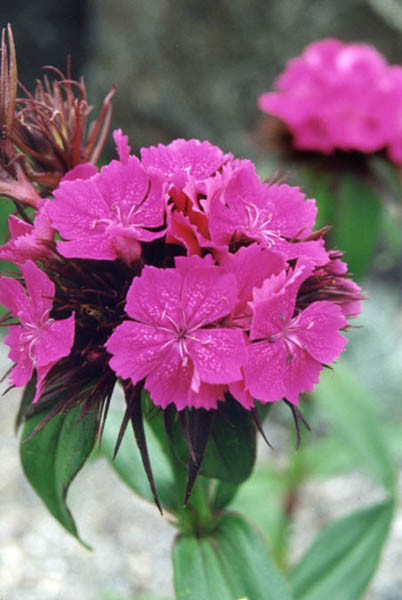
Biennial or short-lived perennial from the Caryophyllaceae family, Dianthus barbatus is native to southern and central Europe, from the Pyrenees to the Balkans and the Carpathians, where it grows in mountain meadows, the edges of light forests, and grassy slopes, generally between 500 and 2,000 meters in altitude. Introduced very early into cultivation, it is now naturalized far beyond its original range and is among the oldest cultivated carnations in Europe.
The plant forms upright clumps of 30 to 60 cm, with lanceolate, broad, and veined foliage, bright green, persisting in a rosette the first year. The flowers, small individually, are gathered in dense and flattened corymbs, surrounded by long and pointed herbaceous bracts — it is this feature, the vegetal beard surrounding each inflorescence, that gives it its name. The cultivated color range is considerable: pure white, soft pink, bright pink, magenta, crimson, blood red, dark burgundy, often with a contrasting eye or darker speckles on the petals. The fragrance, present in the type species, is more or less pronounced depending on the selections.
In its natural habitat, its flowering extends from June to August. In cultivation, it generally occurs from May to July depending on the regions and cultivars.
Very accommodating, it thrives in ordinary, well-drained soil, in the sun or light partial shade. It reseeds easily and can thus maintain itself for several years in the same location. The many available cultivars cover a range from pastel tones to the darkest reds, some with bronze-purple tinted foliage that further enhances the chromatic richness of the whole.