Perennial of the Caryophyllaceae family, Dianthus anatolicus is native to central and eastern Anatolia, as well as the mountainous regions of the Near East. It naturally grows in rocky grasslands, screes, and rock crevices on limestone substrate, at altitudes that can exceed 2,000 meters.
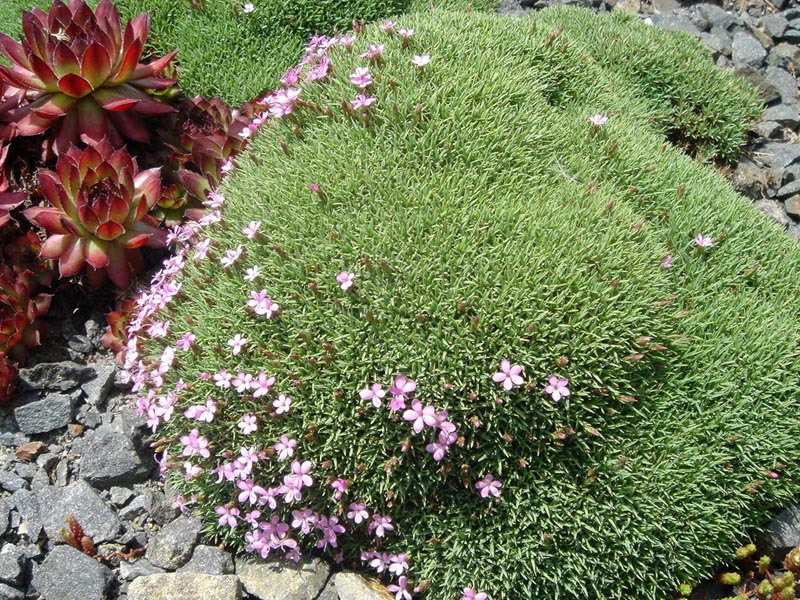
It forms dense, firm, and very regular cushions, of a bright medium green, composed of short, spiky linear leaves. This compact, well-rounded dome shape is one of the most immediately recognizable characteristics of the species, giving the plant an architectural presence even when not in bloom.
The flowers are small, simple, with five barely toothed petals, of a light lilac pink to medium pink, borne on short stems that barely emerge above the cushion. Their regular distribution over the entire surface of the dome creates a very decorative natural seeding effect. In its natural habitat, its flowering extends from June to August depending on altitude. In cultivation, it generally occurs from May to July.
It requires a limestone soil, perfectly drained, in full sun, and tolerates summer drought well once established. It is an ideal choice for well-maintained rock gardens, gravel gardens, or alpine troughs, where the regularity of its habit distinguishes it from most other dwarf carnations.