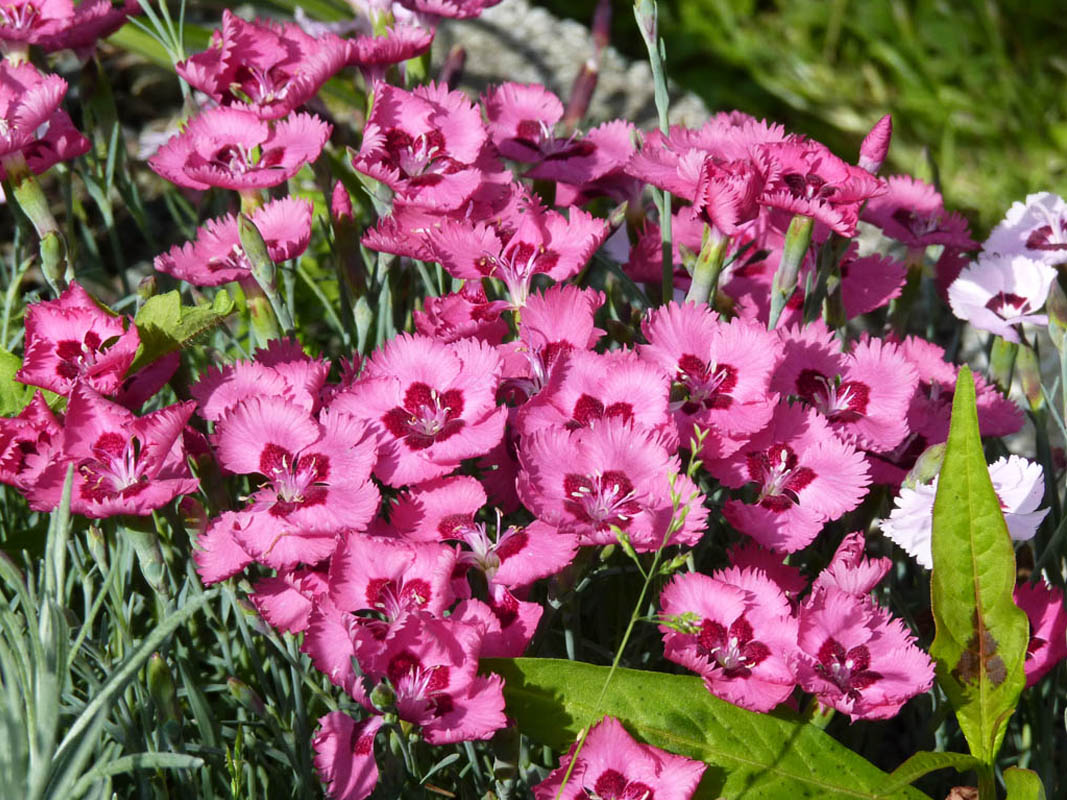
Hybrid perennial of the Caryophyllaceae family, Dianthus x allwoodii is the result of crosses carried out in the early 20th century by the British rosarian and horticulturist Montagu Allwood, mainly between Dianthus plumarius and Dianthus caryophyllus. The goal was to obtain robust, remontant carnations suitable for outdoor cultivation, capable of combining the hardiness of wild species with the floral richness of greenhouse carnations.
The result is a group of perennials forming flexible clumps 20 to 40 cm in height, with narrow, linear foliage, gray-green to glaucous, persisting in winter under a temperate climate. The flowers, borne on slender, upright stems, are simple to semi-double, with strongly fringed petals, available in a wide range from pure white to bright pink, pale lilac, and crimson, often with a contrasting central eye, purple to dark red, surrounded by radiating streaks.
In cultivation, flowering extends from June to September, with a good remontant capacity if faded flowers are regularly removed. The fragrance, inherited from Dianthus plumarius, is present and pleasant in several selections of the group.
These carnations require well-drained soil, preferably calcareous, in full sun. They do not tolerate heavy, wet soils in winter. Their flexible habit and long flowering make them useful in borders, large rock gardens, or in association with other full sun perennials.