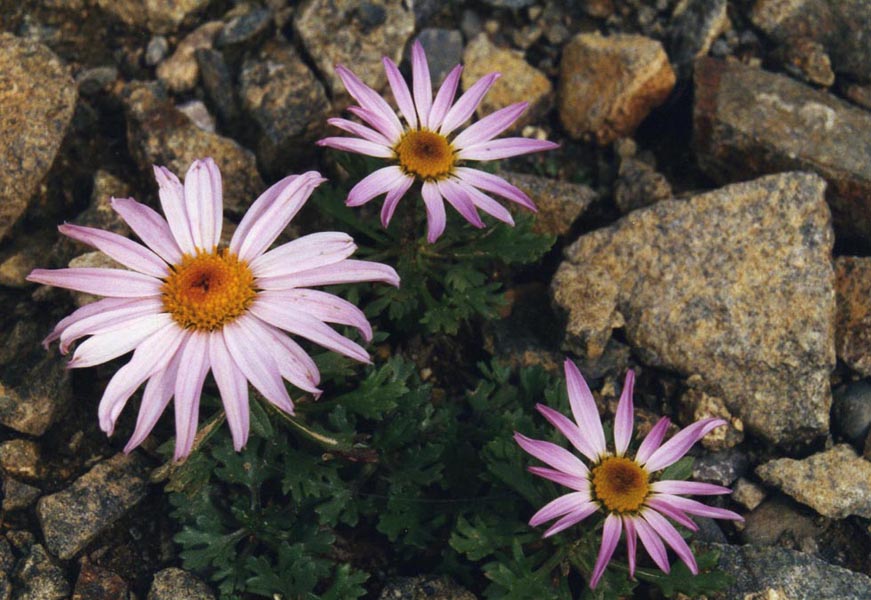
syn. Chrysanthemum weyrichii
syn. Chrysanthemum weyrichii
A perennial from the Asteraceae family, Dendranthema weyrichii is native to Japan and the Russian Far East, where it colonizes rocks, cliffs, and exposed rocky slopes, often near the sea. It is named after the naturalist Heinrich Weyrich, who botanized in these regions in the mid-19th century.
It forms large, very low and dense cushions, barely exceeding 10 to 20 cm in height, spreading widely between rocks. The leaves are deeply lobed, dark green and shiny, leathery and persist late into autumn.
The flowers, large compared to the size of the plant, are borne individually on short peduncles. The ligules are pinkish-white to lilac-pink, often more pronounced on the underside, giving the capitula a subtle bicolored appearance when they tilt. The center is a warm, well-defined yellow-orange. In its natural habitat, it blooms from September to November. In cultivation, it blooms at the same time, when few rock garden perennials are still in bloom.
It requires a sunny exposure, well-drained, rather poor soil, and tolerates fairly severe frosts provided stagnant moisture is avoided in winter. Excellent for rock gardens, walls, and containers exposed to the sun.