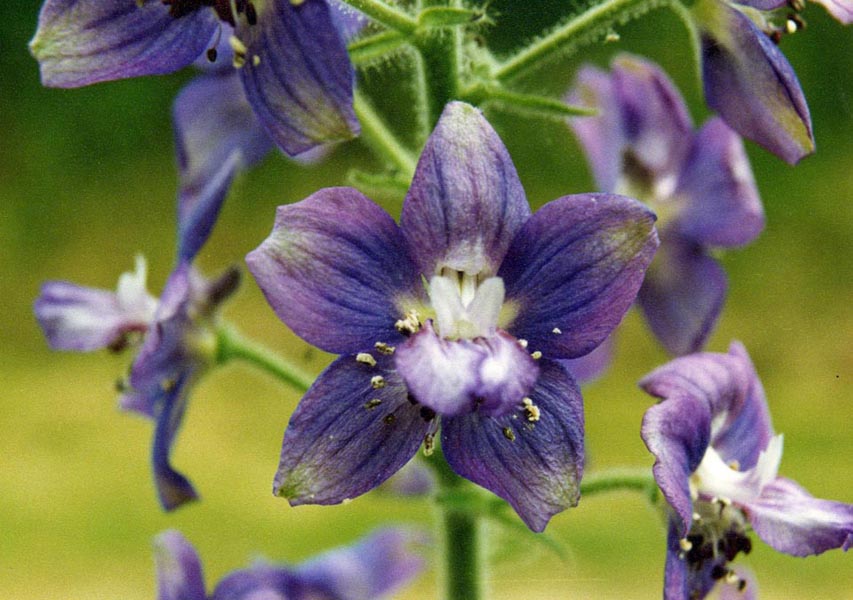
Short-lived perennial, often grown as a biennial, from the Ranunculaceae family, Delphinium staphisagria is native to the Mediterranean basin, the Greek islands, and the Dalmatian coast to Spain and Morocco. It naturally grows on rocky terrains, wastelands, old walls, and open garrigues, at low and medium altitudes.
It forms an upright and branched plant, quite vigorous, reaching 60 to 100 cm in height. The leaves are large, palmately lobed, of a soft green and slightly velvety, which immediately distinguishes it from garden delphiniums with more dissected and firm leaves.
The flowers are gathered in elongated clusters, of a characteristic blue-violet to blue-lilac, each flower bearing a well-visible spur. In its natural environment, its flowering extends from April to June. In cultivation, it occurs roughly at the same dates depending on the exposure.
This species has been known since Antiquity for the toxicity of its seeds, rich in alkaloids, once used in folk medicine against lice — hence its vernacular name of Stavesacre or Lice Herb. All parts of the plant are toxic and should be handled with caution.
In cultivation, it prefers well-drained, slightly calcareous soil, in a sunny exposure. It readily reseeds itself and is suitable for Mediterranean-style gardens or naturalized borders.