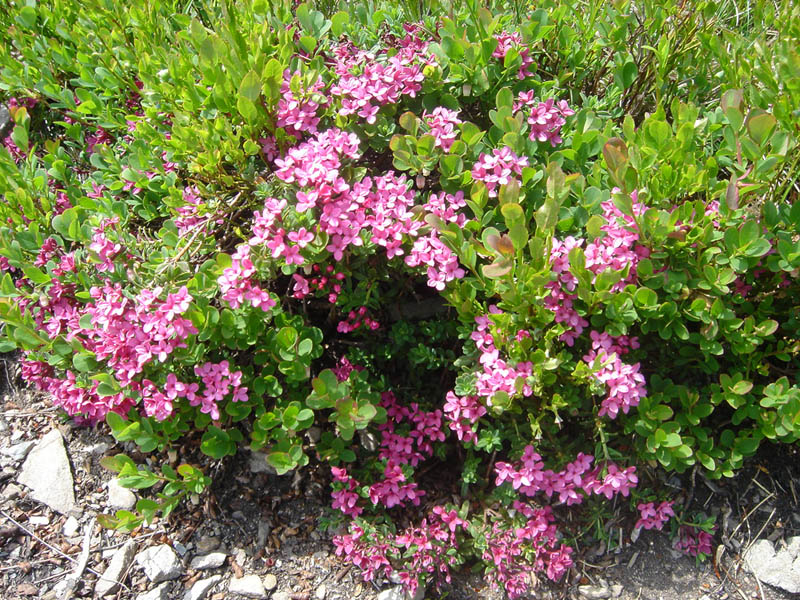
- photographed in the Pyrenees -
- photographed in the Pyrenees -
Thymelaeaceae — Evergreen sub-shrub. The Rock Garland is widespread in central and southern Europe, from the Pyrenees to the Carpathians and the Balkans, where it colonizes dry grasslands, rocky heaths, and the edges of pine forests on limestone, between approximately 500 and 2,000 meters. It favors well-drained, calcareous or mixed substrates, in full light.
It forms a creeping and spreading sub-shrub, with woody prostrate stems, barely exceeding 10 to 30 cm in height but capable of covering a notable area over time. The leaves, evergreen, small, narrowly oblong, are a dull green to grayish-green on the upper side, with a characteristic often whitish margin. The terminal clusters, dense and tight, gather numerous small tubular flowers with four spreading lobes, a bright pink to flesh pink, whose intense and sweet fragrance is one of the most immediately striking features of the species, noticeable from several meters away.
In its natural habitat, its flowering extends from May to June. In cultivation, it occurs in April-May, sometimes with a slight resurgence in autumn.
Like the entire genus, the plant is toxic. It requires a very well-drained calcareous soil, in full sun, and does not tolerate relocation once established. Its growth is slow but the result, at the time of flowering, is spectacular for such a small plant.