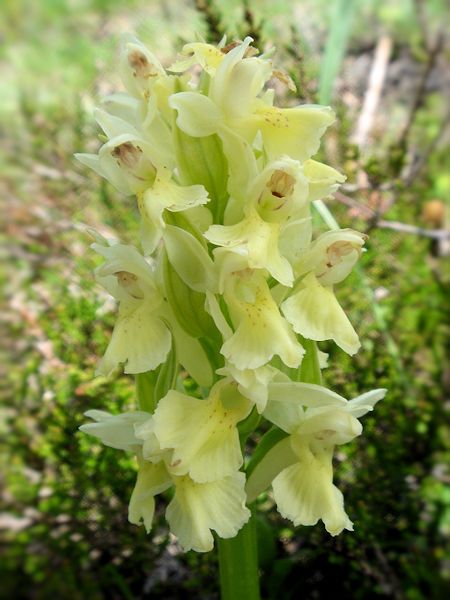
photographed in the Pyrenees
photographed in the Pyrenees
Orchidaceae — Tuberous perennial. The elder-flowered orchid is widespread in the mountains of Europe, from the Pyrenees to the Carpathians and the Apennines, where it grows in alpine grasslands and heaths, clearings, and sparse meadows, generally between 800 and 2,000 meters. It favors acidic to neutral, well-drained soils, in full sun or at the edge of forests.
The plant is modest in size, 15 to 35 cm, with lanceolate, upright leaves of a bright green and unspotted, which immediately distinguishes it from most other Dactylorhiza. The spike is dense and ovoid. The species is remarkable for its chromatic polymorphism: within the same population coexist individuals with sulfur-yellow to cream-yellow flowers and individuals with pink-purple flowers, the two forms being genetically distinct. The labellum, broad and trilobed, is adorned with well-marked red dots and dashes. A slight fragrance reminiscent of elderberry is sometimes noticeable, giving rise to the vernacular name.
In its natural habitat, its flowering extends from May to July depending on the altitude, making it one of the first mountain orchids to bloom in spring.
This orchid is protected. It is not cultivated.