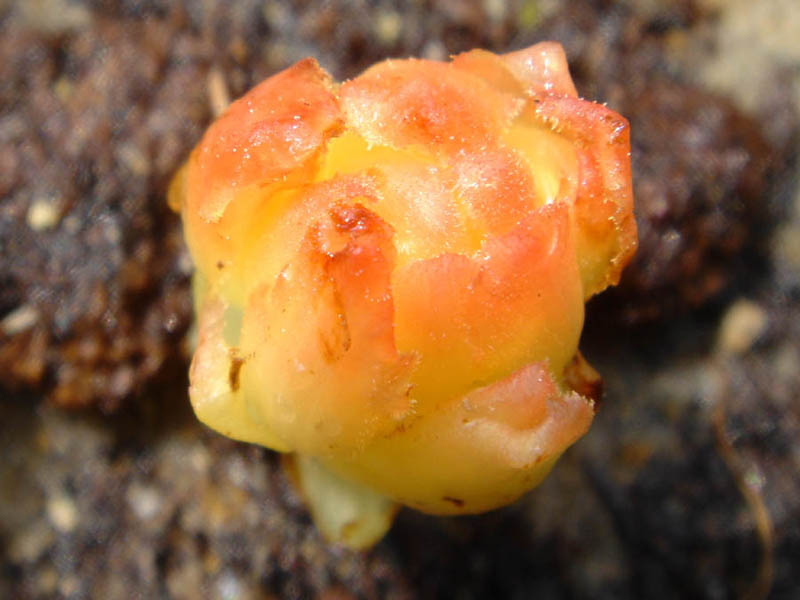
photographed on the Atlantic coast
photographed on the Atlantic coast
A parasitic plant without chlorophyll, from the family Cytinaceae, Cytinus hypocistis is found throughout the Mediterranean basin, from the Iberian Peninsula to Greece and North Africa. It exclusively parasitizes the roots of rockroses, mainly Cistus monspeliensis, C. albidus, and C. salviifolius, in garrigues, maquis, and dry grasslands on siliceous or calcareous soils, in full sun. Its presence is also reported on the Landes coast, where it accompanies Cistus salviifolius in sandy and acidic coastal heaths.
Entirely devoid of leafy stems in the ordinary sense, it emerges directly from the ground at the foot of its host as a compact fleshy bud, consisting of bright yellow to orange overlapping bracts, which gradually open to reveal tightly packed tubular flowers, yellow to orange depending on the individual. It reveals a dense and fleshy structure, almost mineral in appearance, that emerges flush with the ground.
In its natural habitat, its flowering extends from March to June depending on altitude and exposure.
What strikes at first glance is the total absence of any recognizable vegetative organ: no leaves, no green stem, nothing but a brilliant floral mass bursting from the bare ground. The relationship with its host is so close that the plant spends its entire life underground, emerging only to flower and fruit.
Its cultivation is practically impossible outside of reconstituted natural conditions with the corresponding host plant. It appears in collections only for observation in its natural environment.